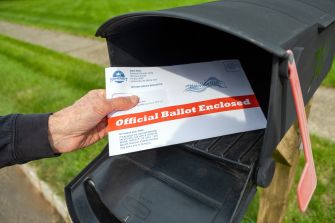
A federal appeals court has refused to let the Trump administration enforce new nationwide mail-ballot requirements for the November midterm elections, ruling that the U.S. Postal Service likely crossed a constitutional line by regulating how states conduct federal elections.
The First U.S. Circuit Court of Appeals on Thursday upheld a preliminary injunctionA preliminary injunction is a temporary court order issued before a case is finally decided that requires a party to take or stop an action while the litigation continues. Federal courts generally consider the likelihood of success, irreparable harm, the balance of equities, and the public interest before granting one.Read more → blocking key parts of a Postal Service rule that would require states to use federally approved ballot envelopes, place voter-specific barcodes on election mail and upload voter information to a USPS database before ballots could be delivered.
The three-judge panel concluded that the rule likely regulates the “manner” of congressional elections, authority the Constitution gives to the states and Congress rather than an executive agency acting without specific congressional authorization.
The Trump administration is now asking the U.S. Supreme Court to intervene. Solicitor General D. John Sauer filed the government’s latest reply Thursday, leaving the dispute before the justices less than two months before the November 3 election. The Supreme Court had not ruled on the emergency application as of Friday.
The case could determine more than whether the new Postal Service requirements apply this year. It raises a broader constitutional question over how far a president can use federal agencies to influence election procedures traditionally controlled by states.
New Postal Rules Would Change How States Handle Mail Ballots
The Postal Service issued its final rule on August 26, only days before some states were scheduled to begin sending ballots for the midterm election.
Under the rule, outgoing and return ballot envelopes would carry voter-specific Intelligent Mail barcodes. The barcode on each envelope would have to match information uploaded to a Postal Service database before the mail could be processed under the new system.
State and local election officials would also have to submit ballot-envelope designs to USPS for approval, replace envelopes that failed to meet the federal standards, and upload voter-specific information through a new online portal. The First Circuit noted that the portal was still not operational when the litigation reached the court.
Noncompliant election mail could be denied delivery.
The requirements trace back to President Donald Trump’s executive order titled “Ensuring Citizenship Verification and Integrity in Federal Elections.” The administration says the measures are intended to improve election security and prevent fraud.
Democratic-led states and voting-rights organizations sued, arguing that the administration had effectively turned the Postal Service into a federal election regulator.
U.S. District Judge Indira Talwani agreed that the challengers were likely to succeed and issued a preliminary injunction on September 4, preventing enforcement of key portions of the rule for elections occurring on or before November 3.
The administration immediately appealed.
The Constitution Gives Election Authority to States and Congress
The First Circuit focused on the Elections Clause of the Constitution.
Article I, Section 4 provides that state legislatures generally determine the “Times, Places and Manner” of congressional elections. Congress retains authority to make or alter those rules.
The executive branch is not given the same power.
The administration argued that USPS was exercising its ordinary statutory authority over the collection, handling, and delivery of mail rather than regulating elections.
The appeals court was unconvinced.
The judges pointed to the rule’s title, “Ballot Mail for Federal Elections,” its exclusive application to election mail and its requirement that state election officials take specific actions before ballots can move through the postal system.
The rule also states that protecting the integrity of federal elections is part of its purpose.
Taken together, the First Circuit found that the requirements likely amount to regulation of election procedures rather than an ordinary postal rule.
The administration relied on federal statutes giving USPS broad power to regulate mail operations, including 39 U.S.C. §§ 401 and 404. The court found those general grants of postal authority insufficient to show that Congress had delegated part of its constitutional election power to the Postal Service.
Congress has historically acted expressly when exercising its Elections Clause authority, the panel said.
The ruling leaves open the possibility that Congress itself could impose federal requirements affecting election mail. The immediate dispute concerns whether an executive agency can do so based on general postal statutes.
Courts Also Saw a Risk to Millions of Mail Voters
The constitutional dispute is unfolding against an increasingly compressed election calendar.
The district court found that states could not realistically implement the new system before November. Some election officials had already purchased and printed ballot envelopes that would have to be replaced.
USPS approval would be required for new envelope designs. Election offices would need technology capable of generating voter-specific barcodes, and officials would have to upload data into a federal portal that was not yet operating.
The Postal Service would then face the task of scanning tens of millions of ballot envelopes and confirming that each barcode matched the information in its database.
The First Circuit said the government had not produced evidence contradicting the district court’s factual findings concerning the logistical problems.
It also pointed to the absence of record evidence showing past mail-ballot fraud or an impending fraud threat connected to the November election. The panel concluded that enforcing the rule now could disenfranchise millions of voters while producing, at most, minimal gains in preventing fraud.
Mail voting is already underway in parts of the country. Nearly one-third of U.S. voters are expected to cast their ballots by mail in the midterms, according to reporting by The Associated Press.
Supreme Court Could Decide Whether the Rules Take Effect
The First Circuit’s decision does not finally resolve the lawsuits.
The court denied requests from the federal government and several Republican-led states to suspend Talwani’s preliminary injunction while the litigation continues. The panel concluded that the administration had not shown a strong likelihood that it would ultimately overturn the district court’s decision.
The Supreme Court could change the immediate result.
USPS and other federal officials filed an emergency application asking the justices to stay the September 4 injunction and allow the rule to take effect. Justice Ketanji Brown Jackson, who handles emergency matters arising from the First Circuit, requested responses from the challengers before the application was considered further.
The government filed its reply on September 10. The Court’s docket showed no ruling as of Friday.
The administration argues that USPS possesses express congressional authority to regulate envelopes and the information necessary for mail delivery. It maintains that the rule is a valid exercise of federal postal power even though it affects ballots.
The challengers contend that accepting that argument would allow the executive branch to accomplish indirectly through postal regulation what the Constitution does not authorize the president to do directly through election law.
The First Circuit sided with the challengers at this stage.
Its ruling also arrives as election officials are already sending ballots and preparing for voting across the country, placing the Supreme Court under increasing pressure to resolve whether the federal requirements can be imposed before November.
A Supreme Court order could come quickly. Whatever the justices decide on the emergency application, the underlying litigation presents a constitutional dispute likely to outlast the 2026 election: when a federal agency regulates the physical machinery used to conduct an election, where does postal authority end and election regulation begin?
Share This Article
If you found this article insightful, consider sharing it with your network.
Lawrence is an attorney and CEO of Law Commentary. His legal background includes corporate and general business law, litigation, transactional matters, and law practice management. His litigation experience has included complex matters involving antitrust, insurance bad faith, and medical malpractice. On the transactional side, Lawrence has worked with buy-sell agreements, Regulation D disclosures, stock option plans, and business matters. Lawrence draws on his legal and business experience to help make court decisions, litigation, legislation, public policy, and other legal developments more accessible to the general public and to give readers clear context for understanding the law and how it affects businesses, consumers, and communities.
A federal appeals court on Monday rejected the Trump administration's emergency effort to block California from counting mail-in ballots from more than 20,000 voters it suspects are noncitizens, allowing election officials to continue processing votes ahead of the November 3 midterm elections.The Ninth U.S. Circuit Court of Appeals ruled 2-1...
Read
More »
A federal judge in Washington, D.C., struck down the Trump administration's nationwide policy of collecting state voter rolls and using federal immigration records to identify suspected noncitizens for removal, ruling that the Justice Department exceeded its legal authority and violated federal privacy protections.U.S. District Judge Sparkle L. Sooknanan issued the...
Read
More »
President Donald Trump’s push to impose new nationwide mail-in ballot rules before the 2026 midterms suffered two setbacks in less than 24 hours, with a second federal judge blocking the U.S. Postal Service plan Sunday and the Supreme Court rejecting the administration’s emergency bid to revive it Monday.The Supreme Court...
Read
More »
The Supreme Court on Friday revived the Trump administration’s expanded voter citizenship-check system, allowing state and local election officials to again use Social Security numbers and other federal records to verify people on voter rolls weeks before the November midterm elections.The justices granted the administration’s emergency request to block a...
Read
More »
The U.S. Supreme Court has blocked Missouri from using a newly drawn congressional map in the November midterm election, stepping into an escalating legal battle that had produced directly conflicting orders from state and federal courts.In an unsigned order issued Thursday, September 10, the justices granted an emergency request from...
Read
More »
We use cookies and similar technologies to help our website function, understand how visitors use our site, and improve your experience. Some cookies are necessary for the website to operate, while others may be used for analytics or advertising.