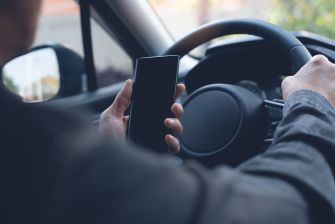
A bill backed by the Louisiana House would fine you for having your cellphone in your hands while driving. Under House Bill 565 (HB565), you would receive a $100 fine on your first offense, a $200 fine on your second offense, and a $300 fine plus driver’s license suspension on your third offense. You would need to use a speakerphone to talk on the phone while driving or use something else hands-free like having your phone connect to your car via Bluetooth. You would also be allowed to use your phone for navigation. Current laws already ban posting to social media and texting while driving in Louisiana for all drivers. If you are under the age of 18, you are not allowed to text or talk on the phone in any manner while driving. However, an exception is made if the minor is reporting criminal or suspicious activity.
Some people believe that this law is not necessary. “I can still drive with one hand, you know. As long as I'm not on it. You shouldn't be worried about it,” Tylon Gallien, a driver in Lafayette, said.
Dayne Huval, the CEO of Southwest Safety Training, a local driving school, says that this law is needed. “People have to remember when you're talking on the phone, there's a cognitive disconnect between your attention on the, on the conversation, compared to your attention on the road. If you're looking at an object for four seconds and you're on the interstate, you travel 400 feet without looking anywhere else. You know that's greater than a football field.”
Rep. Mike Huval (R) says that he has been trying to get this passed for years. “People actually facetime now so instead of looking at the road and speaking, you're actually looking at the phone because you want the person that you’re speaking with to see you,” Rep. Huval said. According to Rep. Huval, 24 other states have passed laws like this. “Fatality rates, and their accident rates have gone down, so it has, it is helping. We should have less fatalities because of this, because people who abide by the law will now be looking ahead, instead of looking to the side to view, facetime or to check their emails, or whatever other things that are available now on a cell phone. It is just to bring that safety back to our roads,” Rep. Huval said.
People against the bill wonder if it would even improve driving conditions and that the poor would be under a financial burden to buy new equipment in order to comply with this law.
“A lot of people don’t have cars that have the ability to talk (on the phone) through the car,” said Rep. Robby Carter, a Democrat from Amite. Some cheap alternatives are to use a speakerphone, ask a passenger to read and respond to your texts or to make phone calls for you, or if you are driving alone and are easily tempted, you can always put your phone away while you are driving.
According to the National Highway Traffic Safety Administration (NHTSA), texting while driving is six times more dangerous than drinking and driving. Also, according to the Transport Research Laboratory, when you send a text message while driving, it slows your reaction time by 35 percent. In contrast, when you drink up to the legal limit, it slows your reaction time by 12 percent.
The bill passed 77-20 in the House and has been sent to the Senate. If this bill is passed, it could go into effect as soon as next year. Exceptions would be made for police officers and firefighters on duty.