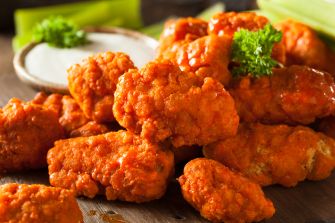
A federal judge in Illinois has dismissed a lawsuit accusing Buffalo Wild Wings of misleading customers by selling chicken breast pieces as “boneless wings,” ruling that the name would not deceive an ordinary diner.
In a 10-page opinion issued Tuesday, U.S. District Judge John J. Tharp Jr. of the Northern District of Illinois rejected claims brought by Illinois resident Aimen Halim. Halim sued in 2023 after ordering the item at an Illinois location in January of that year. He alleged that he expected deboned wing meat but instead received pieces made from chicken breast. He sought up to $10 million in damages and asked the court to require changes to the company’s marketing.
Buffalo Wild Wings operates hundreds of locations nationwide and is known for its chicken wing menu and sports-focused dining. The challenged item is sold across its restaurants under the label “boneless wings.”
Halim argued in court filings that the product is “more akin, in composition, to a chicken nugget rather than a chicken wing.” He claimed he would not have purchased the item, or would have paid less, had he known it was not made from wing portions.
Judge Tharp concluded that the complaint did not state a viable claim under consumer protection lawConsumer protection law is the body of federal and state laws designed to protect people from unfair, deceptive, fraudulent, or abusive practices in the marketplace. These laws regulate areas such as advertising, sales, lending, debt collection, credit reporting, warranties, financial services, and consumer products.Read more →. The court found that alleging he paid for a product he believed was misrepresented was enough to establish standing, the threshold requirement to bring a case in federal court. But the judge held that the allegations did not plausibly show that typical customers are misled by the name.
When courts evaluate advertising disputes, they apply what is known as the reasonable consumer standard. The focus is not on whether one buyer misunderstood a label. Judges ask whether an average customer would likely be deceived. When a term has an established meaning in everyday language, courts generally do not treat it as misleading.
Judge Tharp wrote that “boneless wings” has been used throughout the restaurant industry for more than two decades to describe chicken breast pieces prepared in the style of traditional wings. He characterized the phrase as common shorthand rather than a literal reference to a specific cut of meat. The opinion also pointed to menu items such as cauliflower wings as further evidence that diners do not interpret the word “wings” as a precise anatomical description.
“Words can have multiple meanings,” the judge wrote, noting that “buffalo wing” refers to a style of sauce rather than meat from a buffalo. He concluded that no reasonable diner would believe the product consists of deboned wing meat reconstructed into its original form.
The ruling came at the motion to dismiss stage. At that early phase, a court assumes the facts described in the complaint are true and asks whether the law would allow recovery. Dismissing for failure to state a claim means the allegations, even if accepted as true, do not amount to unlawful conduct.
Similar lawsuits nationwide have challenged food labels that imply specific ingredients or preparation methods. Courts often resolve those disputes by examining how an ordinary buyer would interpret the language in context rather than in a strictly literal sense.
Buffalo Wild Wings argued, according to the opinion, that common usage and menu context make clear the product is not made from wing meat. The court agreed that those factors undercut the claim of deception.
Judge Tharp dismissed the complaint but granted Halim leave to amend. He has until March 20 to file a revised complaint if he can provide additional factual support.
Share This Article
If you found this article insightful, consider sharing it with your network.
Alexandra Agraz is a former Diplomatic Aide with firsthand experience in facilitating high-level international events, including the signing of critical economic and political agreements between the United States and Mexico. She holds dual associate degrees in Humanities, Social and Political Sciences, and Film, blending a diverse academic background in diplomacy, culture, and storytelling. This unique combination enables her to provide nuanced perspectives on global relations and cultural narratives.
Barilla America has defeated a California consumer class action brought by shoppers who said its “Italy’s #1 Brand of Pasta” label led them to believe the pasta was made in Italy with Italian ingredients.U.S. Magistrate Judge Ajay Krishnan granted Barilla summary judgment on September 30, 2026, ending the California class...
Read
More »
A federal judge has reduced a $23.5 million trademark damages award against Beyond Meat to just $37,500, wiping out nearly all of Vegadelphia Foods’ claimed losses while leaving intact a separate $15.4 million award tied to Beyond Meat’s profits.U.S. District Judge Indira Talwani entered judgment of $15,437,500 on September 18,...
Read
More »
Two Texas customers are seeking more than $1.5 million from Popeyes and related companies after claiming they found a condom-like foreign object embedded in fried chicken purchased from a Houston restaurant.Justin Howard of Missouri City and Danielle McKinnon of Katy filed the lawsuit Aug. 3 in Harris County District Court...
Read
More »
United Airlines must face a proposed class action in California federal court over claims that it charged passengers extra for seats labeled as window seats even though some allegedly had no windows, a federal judge ruled.U.S. District Judge James Donato denied the airline’s request to dismiss the lawsuit, allowing breach...
Read
More »
A federal judge in California has dismissed a lawsuit brought by the federal government challenging the state’s egg laws, ruling that it did not show it was directly affected by the rules.
In an order issued March 18, 2026, the U.S. District Court for the Central District of California granted...
Read
More »