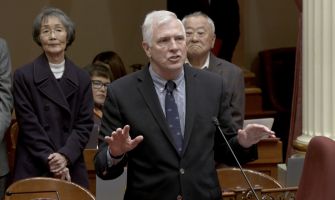
Photo Source: California State Senate official floor-session video. Public-domain state publication under Cal. Gov. Code § 14902.
California lawmakers have approved legislation that would impose new requirements on attorneys who use generative artificial intelligence, including verifying AI-generated work, disclosing its use in court filings, and protecting confidential client information.
Senate Bill 574, known as the Court A.I. Protection Act, passed the Legislature and was sent to Gov. Gavin Newsom for consideration this week. The measure would prohibit attorneys from turning the practice of law over to artificial intelligence while establishing specific duties for lawyers who use AI as an aid in their work.
The legislation comes as tools such as ChatGPT and Claude become increasingly common in legal research, drafting and document review, while courts confront instances in which attorneys have submitted briefs containing cases or citations generated by AI that did not exist.
Under the final version of SB 574, an attorney using generative AI would remain responsible for the legal work produced with the technology. The bill states directly that lawyers cannot “delegate the practice of law” to a generative AI system.
Lawyers would also be required to take reasonable steps to verify the accuracy of AI output, including case and statutory citations, and correct erroneous or fabricated material before using it. Separately, any attorney responsible for a brief, motion, pleading or other paper filed with a California court would have to personally verify every citation contained in the filing, including citations supplied by generative AI.
That requirement addresses one of the most visible problems to emerge from lawyers’ use of generative AI: hallucinations.
Large language models can produce answers that appear authoritative while inventing cases, quotations, statutes, or other information. Courts around the country have sanctioned attorneys after discovering fictitious legal authorities in filed documents.
SB 574 would place the responsibility squarely on the attorney submitting the document. Reliance on an AI tool would not excuse a false citation.
The bill would also require lawyers to disclose the use of generative AI to a court for documents submitted to the court. Attorneys using AI to create material distributed to the public would have to consider whether to disclose its use.
Client confidentiality is another major part of the legislation.
The final bill would prohibit attorneys from entering confidential, personally identifying, or other nonpublic information into a generative AI system if access to that information is not restricted to the attorney and people authorized by the attorney who are themselves obligated to protect its confidentiality.
The provision covers information such as Social Security numbers, dates of birth, medical and psychiatric records, financial information, account numbers, and addresses or telephone numbers belonging to parties, witnesses, victims, and court personnel.
While the bill does not prohibit attorneys from using AI systems with confidential material, it focuses on whether the system adequately limits access to the information entered.
Privacy and confidentiality have become increasingly important legal questions as lawyers and clients use third-party AI platforms.
Earlier this year, U.S. District Judge Jed Rakoff in New York ruled in United States v. Heppner that a criminal defendant’s self-directed conversations with Anthropic’s Claude were not protected by attorney-client privilegeAttorney-client privilege protects confidential communications between a lawyer and a client when they are made for the purpose of seeking or providing legal advice. The privilege generally allows the client to prevent those communications from being disclosed in court or during litigation.Read more → or the work product doctrineThe work product doctrine protects certain materials prepared by or for a lawyer, party, or representative in anticipation of litigation or for trial. It is designed to keep an opposing party from gaining access to an attorney’s legal strategy, mental impressions, and litigation preparation.Read more →. The court concluded, in part, that the defendant disclosed information to a third-party AI platform and lacked a reasonable expectation that the communications would remain confidential.
Although Heppner involved a client rather than a lawyer using AI, the case illustrates concerns about sensitive legal information entered into generative AI platforms.
California has already addressed those risks through professional guidance. The State Bar of California updated its Practical Guidance for the Use of Generative Artificial Intelligence in the Practice of Law in May 2026. The guidance addresses attorney competence, confidentiality, supervision, communications with clients, and a lawyer’s duty of candor to courts.
The California Supreme Court also directed the State Bar in 2025 to consider incorporating AI-related principles into the Rules of Professional Conduct. Proposed changes now under consideration would clarify that attorneys remain responsible for exercising professional judgment over both the information entered into AI systems and the material those systems produce.
SB 574 would move some of those concepts beyond professional guidance by placing specific requirements into California law.
The legislation extends beyond attorneys.
Arbitrators would be prohibited from delegating any portion of their decision-making responsibilities to generative AI. An arbitrator also could not rely on information generated by AI outside the evidentiary record without first disclosing its use to the parties and, when practical, giving them an opportunity to respond.
The bill would additionally require the California Judicial Council to revisit its standards governing judicial use of generative AI as the technology continues to develop.
Sen. Thomas Umberg, a Democrat from Santa Ana and chair of the Senate Judiciary Committee, introduced the legislation. His office said the measure is intended to protect people receiving legal services by establishing rules governing AI use by attorneys and arbitrators.
The Senate concurred in the Assembly’s amendments on August 31 by a 39-0 vote, sending the measure to Newsom.
The governor has not yet signed the bill, so its requirements are not currently law in California.
If enacted, SB 574 could become an important test of how states regulate artificial intelligence without prohibiting lawyers from using the technology altogether. The approach accepts that generative AI will increasingly become part of legal practice while preserving a basic principle of professional responsibility: the lawyer, rather than the software, remains accountable for the work presented to clients and courts.
Share This Article
If you found this article insightful, consider sharing it with your network.
Lawrence is an attorney and CEO of Law Commentary. His legal background includes corporate and general business law, litigation, transactional matters, and law practice management. His litigation experience has included complex matters involving antitrust, insurance bad faith, and medical malpractice. On the transactional side, Lawrence has worked with buy-sell agreements, Regulation D disclosures, stock option plans, and business matters. Lawrence draws on his legal and business experience to help make court decisions, litigation, legislation, public policy, and other legal developments more accessible to the general public and to give readers clear context for understanding the law and how it affects businesses, consumers, and communities.
California employers will be prohibited from relying solely on artificial intelligence to fire or discipline workers under legislation signed by Gov. Gavin Newsom on September 30, 2026. The law requires companies to independently verify certain AI-generated recommendations before taking action and grants employees access to information used against them.Senate Bill...
Read
More »
Anthropic, the company behind the Claude AI chatbot, has privately pitched lawmakers its own federal AI safety bill that would restrict when the government can block dangerous artificial intelligence models, even as it establishes new oversight requirements for the industry.Under the proposal, federal officials could seek to suspend an advanced...
Read
More »
A federal appeals court is moving to tighten its rules on artificial intelligence after judges encountered court filings containing fabricated cases, false quotations and other AI-generated legal errors.The U.S. Court of Appeals for the Tenth Circuit proposed a new rule September 18 that would require lawyers and self-represented litigants to...
Read
More »
California customers stuck in automated customer service systems will have a new way to reach a live agent under a law signed by Gov. Gavin Newsom that requires large companies to make a good-faith effort to connect them within 15 minutes.Newsom signed Assembly Bill 1609, the Right to Human Customer...
Read
More »
California will require advertisers to tell consumers when a realistic actor selling a product or service was generated by artificial intelligence under a new law signed Wednesday by Gov. Gavin Newsom.Senate Bill 1050 requires a clear and conspicuous disclosure when an audio, video or audiovisual advertisement prominently features an AI-generated...
Read
More »
We use cookies and similar technologies to help our website function, understand how visitors use our site, and improve your experience. Some cookies are necessary for the website to operate, while others may be used for analytics or advertising.