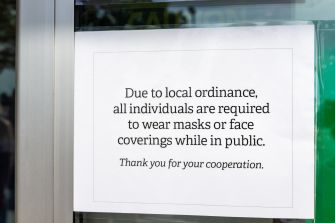
With the majority of states currently requiring their citizens to wear masks in public, there has been pushback. People against mask mandates are saying that the government cannot make the public wear masks because there is no legal basis for it, and therefore it is not constitutional. However, is this true?
In the past, the United States has enforced similar measures in the name of public health. During the 1918-1919 flu pandemic, some cities in the United States required people to wear masks. If you did not wear a mask, you were subject to the possibility of citations and fines. If you wanted to contest the fine, you would appear in front of a municipal judge who would decide whether or not you still had to pay it. The Arizona Supreme Court, at the time, said the following: “Necessity is the law of time and place, and the emergency calls into life the necessity … to exercise the power to protect the public health.” Also, during the midst of a smallpox outbreak in 1905, the U.S. Supreme Court allowed for local governments to mandate that people obtain smallpox vaccines or receive a fine using the following reasoning: “Upon the principle of self-defense, of paramount necessity, a community has the right to protect itself against an epidemic of disease which threatens the safety of its members.”
A similar example to the mask mandate is the ability of the government to ban smoking in many places for the sake of the general health of the public. Even though there is no public health emergency, the government has the ability to enforce these bans using the state’s police power. The evidence of the harm of secondhand smoke provides enough of a reason to keep the bans in place.
Smoking bans are not made to protect the smoker; they are made to protect the people around them from secondhand smoke. The same goes for masks. The masks are made to protect other people from inhaling any respiratory droplets that could contain COVID-19. The masks are not made to protect the wearer of the mask from others. Since the CDC estimates that about 35 percent of people who are infected with COVID-19 have no symptoms, people could be spreading the virus to others without knowing it if they choose not to wear a mask. However, some people cannot wear a mask due to certain medical conditions and should receive the proper accommodations according to the Americans with Disabilities Act (ADA). In the United States District Court of Maryland case of KOA v. Hogan upholding the state’s mask mandate, the court noted the following guidance issued by the Maryland Department of Health: “People with disabilities who are unable to wear a mask are provided reasonable accommodations per the Americans with Disabilities Act.”
Lindsey Wiley, the director of the Health Law and Policy Program at American University, believes that there is a legal basis for the government to require you to wear a mask or face covering and that state and local governments have a wide range of authority to do so since we are in an emergency. Businesses can require customers to wear masks on their own if that is something they want to do to protect their employees or customers. However, this decision can cause a rift between the business and customers if the customers know that the requirement comes from the business itself and not a government mandate. Therefore, some businesses are asking their local governments to require the use of face coverings in places of business so that if customers have a problem with the mask mandate, the business can tell them to take it up with the government.
Requiring employees to wear masks in certain industries is a little bit easier to enforce. For example, based on the 2016 New York court case Spence v. Shah, medical employers can require a nurse to wear a mask if they do not get a flu vaccine.
The legality of mask mandates may continue to play out in courts across the nation, but legal precedent and history seem to support the proposition that mask mandates in response to the risk of COVID-19 are valid and enforceable.