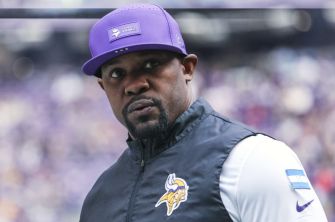
A federal judge has ruled that former Miami Dolphins head coach Brian Flores may pursue his discrimination lawsuit against the National Football League in open court rather than through the league’s arbitration system.
In a decision issued Friday, Judge Valerie Caproni of the Southern District of New York held that Flores and two other coaches may move forward with their claims in federal court. The NFL had argued that Flores’ contract required employment disputes to be resolved through arbitration, a private process governed by league rules. The court rejected that request, allowing the case to proceed before a federal judge.
Flores, who now serves as defensive coordinator for the Minnesota Vikings, filed the lawsuit in February 2022 after he was fired by the Dolphins the previous month. He alleges that the NFL and several teams engage in discriminatory hiring practices that disadvantage Black coaches. The complaint states that the league’s system is “rife with racism” in the way it conducts interviews and selects head coaches and senior personnel.
The lawsuit names the NFL as well as the Denver Broncos, New York Giants, and Houston Texans. Flores alleges that the Broncos interviewed him in 2019 without seriously considering him for the head coaching position. He also claims that the Giants and Texans conducted interviews in 2022 to satisfy diversity requirements while intending to hire other candidates.
Two other coaches later joined the case. Steve Wilks alleges that the Arizona Cardinals hired him in 2018 as what he describes as a “bridge coach,” suggesting he was not given a meaningful opportunity to succeed. Ray Horton alleges that the Tennessee Titans did not provide him with a genuine interview for a head coaching position in 2016.
The NFL sought to move the case to arbitration, arguing that league employment agreements require disputes to be handled outside the public court system. Arbitration is a private system for resolving disputes outside a courtroom, often required by employment contracts. A neutral decision maker reviews evidence and issues a binding ruling. The process typically limits public access and court oversight.
Federal law, including the Federal Arbitration Act, generally supports enforcing arbitration agreements. But courts must first determine whether such agreements are valid and enforceable. Judges may decline to compel arbitration if the structure would undermine federal statutory rights or lack basic neutrality. Flores’ attorneys argued that the league’s rules would allow its chief executive to decide the dispute, raising concerns about fairness. Judge Caproni concluded that the claims may proceed in federal court.
Proceeding in federal court changes how the case will be handled. The public judicial process allows both sides to use formal discovery tools to obtain documents and sworn testimony under court supervision. Hearings and rulings become part of the public record, and decisions may be appealed. Those safeguards are often central when claims involve federal civil rights law.
The claims arise under Title VII of the Civil Rights Act of 1964, which prohibits employers from discriminating based on race in hiring, firing, and other employment decisions. The statute allows individuals to sue in federal court and seek remedies that may include monetary damages, back pay, and court-ordered changes to workplace policies.
The lawsuit also references the NFL’s Rooney Rule, a league policy requiring teams to interview minority candidates for certain coaching and executive positions. The rule is not a federal statute, and compliance with it does not shield an employer from liability under Title VII. Flores and the other coaches argue that some teams treated required interviews as formalities rather than genuine opportunities, conduct they allege violates federal civil rights law.
The NFL has denied wrongdoing and has defended both its hiring practices and its arbitration system in court filings. The league has argued that its dispute resolution procedures are lawful and consistent with federal policy favoring arbitration agreements.
A pretrial hearing is scheduled for April 3 in the Southern District of New York.