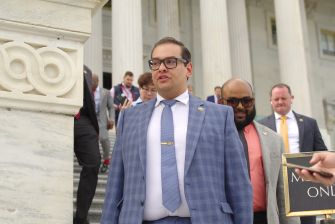
Former U.S. Rep. George Santos has received the first lifetime ban in Kalshi’s history and was fined $71,356 after the prediction market concluded that he improperly traded contracts tied to his own attendance at President Donald Trump’s State of the Union address.
Santos made nearly $18,000 trading on whether he would attend the February 24 speech, including positions that gained value as he publicly discussed his plans to appear and later bet that he would not attend.
Kalshi announced the permanent ban Monday after its compliance department found reasonable cause to believe Santos engaged in prohibited trading and made false or misleading public statements that influenced contract prices. The company said his failure to cooperate with its investigation contributed to the lifetime penalty.
The action follows a separate federal case over the same trades. In July, the Commodity Futures Trading Commission ordered Santos to surrender $17,569.98 in profits, pay a $17,500 civil penalty and stop trading on CFTC-regulated markets for three years.
Santos opened a Kalshi account in February and traded in a market asking whether he would attend the State of the Union. Because the outcome depended on his own decision to appear, he had direct control over the event at the center of the contracts.
He initially bought contracts that would increase in value if he attended. On February 22, while holding that position, Santos asked followers on X whether he should wear a muted suit or a “bedazzled one” to the speech.
Contracts predicting his attendance climbed from 15 cents to 70 cents within hours. Santos then sold his position for a profit of more than $3,400.
His travel plans changed as winter weather disrupted transportation to Washington. After a flight was canceled, Santos booked a train and continued publicly discussing plans to attend the speech.
On February 23, Santos told followers he would be in the House gallery. The price of contracts predicting his attendance rose again. About 40 minutes later, according to the CFTC, he began buying contracts that would pay if he did not attend.
The train was later canceled. Regulators said Santos continued indicating publicly that he planned to attend without disclosing that both of his booked routes to Washington were no longer available.
On the evening of the State of the Union, Santos posted that he was watching the speech on an airport television. Contracts predicting his attendance fell from 73 cents to 2 cents, increasing the value of his position betting that he would not appear.
Santos closed that position early the next morning for a profit of more than $14,000.
Kalshi prohibits people from trading in markets when they can control or materially influence the underlying event. The restriction is designed to prevent traders from using information or authority unavailable to other participants to profit from an outcome they can help determine.
The Santos trades also fell under federal commodities law because Kalshi operates as a CFTC-regulated derivatives exchange. Federal rules prohibit deceptive or manipulative conduct intended to affect the price of contracts traded on those markets.
The CFTC found that Santos violated those rules by trading on his own attendance while making misleading statements and withholding information about his travel that could affect prices. He settled the federal case without admitting or denying the agency’s findings.
Santos’ attorney previously said he denied intentionally deceiving traders or manipulating the market and agreed to resolve the CFTC proceeding to avoid prolonged litigation.
Kalshi’s action goes further than the federal trading ban. The company permanently barred Santos from its platform after concluding that his conduct violated its own rules and citing his lack of cooperation with the compliance investigation.
The company also announced penalties Monday against three current or former political candidates accused of trading contracts tied to their own elections. North Carolina congressional candidate Laurie Buckhout and former gubernatorial candidates Stephen Cloobeck of California and Ben Midgley of Maine received temporary bans rather than lifetime suspensions.
Kalshi said those cases were handled differently because the traders cooperated with its investigation.
Santos criticized the decision on X, calling the proceeding “frivolous nonsense” and thanking Kalshi for banning him from what he described as its “gambling platform.”
The former New York Republican was expelled from the House in December 2023 and later pleaded guilty to federal wire fraud and aggravated identity theft charges. He was sentenced to more than seven years in prison before Trump commuted his sentence in 2025 after Santos had served 84 days.