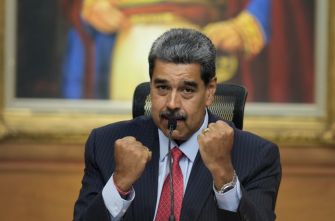
A federal grand jury in New York has issued a sweeping indictment accusing Venezuelan President Nicolás Maduro and senior members of his inner circle of leading a decades-long narco-terrorism conspiracy that allegedly sent massive quantities of cocaine into the United States.
The superseding indictment, filed in the U.S. District Court for the Southern District of New York, alleges that Maduro and several co-defendants used the power of the Venezuelan government to protect drug traffickers, coordinate international cocaine shipments, and provide material support to violent criminal and terrorist organizations. Prosecutors say the scheme began as early as 1999 and continued through 2025.
According to federal prosecutors, Maduro played a central role in what authorities describe as the “Cartel de los Soles,” a network of Venezuelan political and military officials accused of exploiting state institutions to facilitate drug trafficking. The indictment claims Venezuela became a key transit hub for cocaine produced in Colombia, with shipments moving north through Central America, Mexico, and the Caribbean before reaching the United States.
The case names multiple high-ranking figures, including Venezuela’s interior minister Diosdado Cabello, former interior minister Ramón Rodríguez Chacín, Maduro’s wife Cilia Flores, his son Nicolás Ernesto Maduro Guerra, and the alleged leader of the Tren de Aragua criminal organization. Prosecutors allege the defendants worked together to provide security, weapons, transportation, and diplomatic protection for large-scale cocaine shipments.
U.S. authorities further allege that the conspiracy involved partnerships with organizations designated by the United States as foreign terrorist groups, including factions of Colombia’s FARC and ELN guerrillas, as well as Mexico-based drug cartels. The indictment accuses the defendants of knowingly supplying cocaine and other support to these groups in exchange for protection, logistical assistance, and shared profits.
In addition to narco-terrorism conspiracy charges, the indictment includes counts for cocaine importation, firearms offenses, and conspiracy to possess machine guns and destructive devices. Prosecutors allege that military-grade weapons were used to protect drug routes and enforce control over trafficking operations.
Federal law allows prosecutors to bring charges even though much of the alleged conduct occurred outside the United States, because the indictment claims the defendants knowingly conspired to import cocaine into the country and support terrorist organizations whose activities affect U.S. interests.
Maduro has repeatedly denied similar accusations in the past, dismissing them as politically motivated. Venezuela’s government has rejected U.S. jurisdiction and has refused to extradite officials facing American charges. There is no indication that Maduro or the other defendants will appear in a U.S. court in the near future.
Still, the indictment carries significant legal consequences. It exposes the defendants to potential life sentences if convicted, authorizes the seizure of assets tied to the alleged crimes, and reinforces U.S. sanctions targeting Venezuela’s leadership. The case also reflects the Justice Department’s continued effort to treat large-scale drug trafficking as a national security threat when it intersects with terrorism.
What Is Narco-Terrorism?
Under U.S. law, narco-terrorism refers to drug trafficking carried out in coordination with terrorist organizations or with the intent to support terrorist activity. Prosecutors must show not only large-scale narcotics crimes, but also that defendants knowingly provided financial or material support to groups designated as terrorist organizations. In this case, the government alleges that cocaine profits helped fund violent groups operating across Latin America, while those groups, in turn, protected drug routes and shipments bound for the United States.