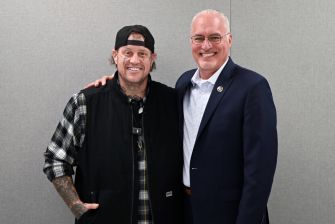
Jelly Roll has been formally pardoned by Tennessee Governor Bill Lee, closing a chapter on a criminal record that has long shadowed, and in many ways, shaped the country-rap artist’s career. The decision, first reported by the Associated Press, was finalized Thursday after months of review by state officials.
Governor Lee described the pardon as emblematic of the kind of transformation the clemency process is meant to recognize. “His story is remarkable,” Lee told reporters. “It’s a redemptive, powerful story, which is what you look for and what you hope for.”
The pardon follows an April 23 hearing before the Tennessee Board of Parole in Nashville, where board members spent nearly two hours reviewing Jelly Roll’s criminal history, personal testimony, and post-conviction conduct. The board ultimately voted unanimously to recommend clemency, citing the artist’s sustained rehabilitation efforts and community involvement. Governor Lee signed off on the recommendation this week.
Born Jason DeFord, Jelly Roll has been open about his past for much of his public life. As a teenager and young adult, he accumulated multiple convictions related to drug offenses and robbery, serving time in both juvenile detention and adult incarceration. His last sentence expired more than five years ago, and he formally petitioned the parole board for a pardon in October 2024, marking that milestone.
At the April hearing, DeFord framed his request not as an erasure of the past, but as a step toward broader opportunity, both professionally and personally. While the convictions have not prevented him from achieving commercial success in the United States, they have severely restricted his ability to tour internationally.
“Every time I want to play outside the country, it takes a team of lawyers and a mountain of paperwork,” DeFord told the board. “In most cases, it’s just not possible.” As a result, his touring outside North America has been largely limited to Canada.
In remarks following the board’s recommendation, DeFord acknowledged the uncertainty surrounding the governor’s final decision. “This was incredible,” he said at the time. “I pray this goes through. But today was special for me regardless.”
Beyond logistics, DeFord emphasized the symbolic weight of a pardon, particularly given his role as a public figure whose audience includes people grappling with addiction, incarceration, and systemic barriers. “I want to be an inspiration for people who are now where I used to be,” he told the board. “To let them know that change is truly possible.”
In recent years, Jelly Roll has increasingly positioned himself as an advocate for rehabilitation and recovery. He regularly visits prisons and juvenile detention centers, speaks at addiction-recovery programs, and has publicly encouraged therapy, creative expression, and faith-based support as tools for healing. Earlier this year, he addressed participants in a Helping Addicts Recover Progressively program, urging them to pursue “anything that turns pain into purpose.”
Governor Lee initially signaled cautious optimism about the case earlier this year, noting that the process required careful consideration. “The reporting on Jelly Roll, that’s encouraging for his situation,” Lee said at the time, according to the Associated Press. “But there are steps yet to happen in that case.”
Those steps are now complete. The pardon restores DeFord’s civil standing in Tennessee and removes legal barriers tied to his convictions, including many that complicated international travel. While it does not rewrite history, it formally recognizes sustained rehabilitation, a distinction the governor’s office has said is central to the state’s clemency philosophy.