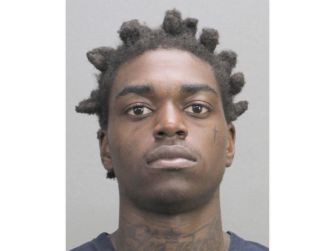
Kodak Black surrendered to authorities in Florida this week after police issued an arrest warrant accusing the rapper of trafficking MDMA in Orange County.
According to inmate records, the artist, born Bill Kahan Kapri, was booked into the Orange County jail after turning himself in on May 6. Authorities allege Kapri possessed more than 10 grams but less than 200 grams of MDMA, a quantity that meets Florida’s trafficking threshold under state law.
The charge stems from an investigation tied to a November 2025 incident in Orlando, according to statements provided by the Orlando Police Department.
A department spokesperson said officers initially responded to reports of gunfire near Fairvilla Road before searching multiple vehicles in the area. During the investigation, police arrested another man, identified as James Twitty, on separate firearms and cannabis-related charges.
Authorities later claimed laboratory testing confirmed the presence of MDMA in evidence recovered from one of the searched vehicles. Police then sought an arrest warrant for Kapri.
“Following further investigation and laboratory results confirming the presence of MDMA in an amount exceeding the trafficking threshold, probable cause was established,” an Orlando Police Department spokesperson said in a statement. “On May 6, 2026, Bill Kapri turned himself in and is currently in custody at the Orange County jail.”
Police declined to provide additional information, citing the ongoing nature of the case. Kapri’s attorney, Bradford Cohen, disputed the basis for the charge and described the arrest as a “coordinated surrender” rather than an unexpected arrest operation. According to Cohen, investigators recovered a bag during the November vehicle search that allegedly contained several items, including a bottle of prescription cough syrup. Kapri was reportedly not inside the vehicle at the time officers searched it.
Cohen said prosecutors are attempting to connect the rapper to the evidence through fingerprint analysis, though he strongly challenged both the strength and accuracy of that claim.
“Instead of simple possession, they doubled down and filed it as a trafficking charge,” the attorney added. “I will be fighting the charge.”
In a later statement, Cohen went further, saying no usable fingerprints had actually been recovered from any of the seized items. “His prints were not on any of the items,” Cohen said. “This is a clear case of targeting.”
The attorney also argued that law enforcement and prosecutors have repeatedly pursued weak or inflated cases against the rapper because of his public profile and criminal history.
“This is an ongoing theme where cases that would normally not be filed due to a weak legal basis are filed against Mr. Kapri,” Cohen said. “We look forward to yet another fruitful resolution to another case that should have never been filed.”
Kapri has faced numerous legal issues throughout his career, including both state and federal convictions. In 2019, he pleaded guilty in federal court to making false statements on firearms purchase forms and was sentenced to 46 months in prison. Former President Donald Trump later commuted the sentence after Kapri served roughly 10 months. Before that, the rapper had also been convicted on state charges tied to assault and battery allegations.
Despite recurring legal troubles, Kodak Black has remained commercially active over the past decade, building a devoted fan base through a prolific release schedule and a string of charting singles. Emerging from Florida’s rap scene in the mid-2010s, he became known for songs including Tunnel Vision and Super Gremlin, the latter becoming one of the biggest rap hits of the early 2020s.
His most recent album, Just Getting Started, was released in late 2025 and reached Number 77 on the Billboard 200 chart.