Nevada sued the U.S. Department of the Interior on Monday over a Colorado River plan that state officials say could eventually cut its annual water allocation by more than 70 percent, opening the first state challenge to the federal government’s new rules for the shrinking river.
The state filed the case in federal court alongside the Colorado River Commission of Nevada and the Southern Nevada Water Authority. The complaint argues that Interior and the Bureau of Reclamation failed to properly apply the laws governing the river and did not fully examine the effects of the new operating framework before adopting it.
For 2027 and 2028, Nevada would give up 50,000 acre-feet of Colorado River water each year under a proposed Lower Basin sharing agreement incorporated into the federal plan. Nevada is normally entitled to 300,000 acre-feet annually. An acre-foot is about 326,000 gallons of water.
The 71 percent figure concerns the longer-term framework. Nevada says its annual reduction could reach 213,556 acre-feet if Lower Basin shortages rise to 3.6 million acre-feet, leaving the state with less than 86,500 acre-feet. Southern Nevada used about 198,000 acre-feet in 2025, and the Colorado River supplies roughly 90 percent of the water used in Las Vegas and surrounding communities.
Nevada says the region has already cut its Colorado River use by about 40 percent over the past 25 years while adding more than 800,000 residents. State water officials argue that deeper reductions would threaten their ability to meet Southern Nevada’s basic water needs.
Arizona, California and Nevada face mandatory reductions under the plan, while conservation measures for Colorado, New Mexico, Utah and Wyoming remain voluntary. That difference is central to Nevada’s challenge.
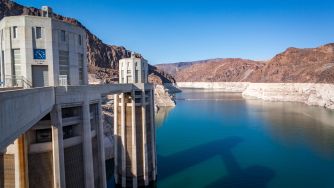
Interior says the framework is designed to protect Lake Powell, Lake Mead and the federal infrastructure that depends on them as prolonged drought continues to strain the river. The department said the rules followed three years of work with the seven basin states, tribes and other stakeholders and incorporate proposals from both the Upper and Lower basins. Lake Mead and Lake Powell have recently fallen to record lows.
The Law of the River is a network of interstate compacts, federal laws, court rulings, contracts, and operating rules that have governed the Colorado River for more than a century.
A central part of that system is the 1922 Colorado River Compact, which divided the river into an Upper Basin and a Lower Basin. Lower Basin states receive specific allocations through federal contracts, while Upper Basin states operate under different compact obligations governing their use of the river. Those different legal structures are part of the dispute over how shortages should be shared.
Nevada argues Interior must account for the broader obligations imposed by the compact and other parts of the Law of the River when deciding how shortages are shared. The state claims the agency failed to resolve those legal questions before adopting its framework.
The lawsuit also challenges the decision under the National Environmental Policy Act, or NEPA. Under NEPA, federal agencies considering major actions must study reasonably foreseeable environmental effects and consider a reasonable range of alternatives before making a final decision. Nevada argues Interior’s review fell short of those requirements.
Nevada claims Interior’s review failed to fully examine the economic, population, land use, public health, and groundwater effects of steep reductions in Southern Nevada. The complaint also cites possible effects on Lake Mead infrastructure, hydropower, and cultural and tribal resources and challenges the methods used to evaluate water deliveries and reservoir operations under severe shortage conditions.
The state also disputes the alternatives Interior considered. Nevada argues the agency should have more fully studied options that spread conservation measures across both basins and says Interior failed to carry forward a Lower Basin proposal that the state contends would have better complied with existing river law.
Nevada is asking the court to set aside Interior’s environmental review, record of decision, and operating guidelines under the Administrative Procedure Act, which allows courts to review final federal agency actions. The state also seeks to block the rules until Interior complies with the Law of the River and NEPA.
The case remains pending in the U.S. District Court for the District of Nevada. No hearing date has been set.