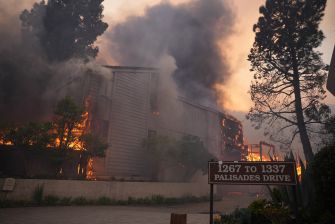
A federal judge declared a mistrial Friday in the arson case against Jonathan Rinderknecht and set an Oct. 19 retrial after jurors deadlocked over whether prosecutors proved he started a New Year’s fire that later became the deadly Palisades Fire in Los Angeles.
U.S. District Judge Anne Hwang ordered Rinderknecht held in custody until the new trial after the jury split 10 to 2, with 10 jurors voting to acquit and two voting to convict. Rinderknecht, a former Uber driver, is accused of setting the Lachman Fire in the hills above Pacific Palisades and faces three federal charges.
Hwang found a “manifest necessity” after jurors said they were deadlocked on all three counts. Rather than press the panel to continue, she ended the trial without a verdict.
Manifest necessity is a narrow basis for ending a criminal trial before a verdict when a serious problem prevents the case from continuing fairly. The standard can apply to a deadlocked jury, severe juror misconduct, sudden illness, or an error so serious that any conviction would likely be overturned later.
A mistrial supported by manifest necessity generally allows prosecutors to try the case again without violating the Fifth Amendment’s Double Jeopardy Clause. The clause protects a person from being prosecuted again for the same offense after an acquittal or conviction.
Rinderknecht, 29, has pleaded not guilty to destruction of property by means of fire, arson affecting property used in interstate commerce, and timber set afire. The prosecution claims he deliberately started the Lachman Fire around New Year’s 2025, and that the blaze continued burning underground before strong winds caused it to flare back up into the Palisades Fire on Jan. 7.
The Palisades Fire killed 12 people, burned more than 23,000 acres in Pacific Palisades, Malibu, and the Santa Monica Mountains, and destroyed more than 6,800 structures. The fire was fully contained on Jan. 31, 2025, after 24 days.
The government’s case rested on a “holdover fire” theory. Prosecutors argued that firefighters suppressed the first blaze, but that flames or heat remained hidden in underground root systems until Santa Ana winds drove the fire into nearby communities days later.
Causation became a central issue at trial. The prosecution had to connect the alleged first fire to the later destruction, but the defense argued that the government could not prove the link beyond a reasonable doubt.
The trial began on June 8 and included eight days of testimony from investigators, experts, and witnesses from nearby areas. Jurors deliberated for about 13 hours over two days before reporting that they could not agree.
Phone data, witness testimony, and video evidence formed the core of the government’s proof at trial. Federal attorneys argued that the records placed Rinderknecht near the ignition area as the Lachman Fire began to spread and conflicted with his later statements about the night. Prosecutors also claimed he used a barbecue lighter to start the blaze.
Prosecutors also used digital records to address motive and intent, presenting material from Rinderknecht’s phone, email, Uber, OpenAI, and social media accounts. The evidence included ChatGPT exchanges about anger and Reddit searches tied to wealth and violence, which the government claimed supported its theory that the fire was intentional and rooted in resentment toward wealthy residents of Pacific Palisades.
Rinderknecht’s defense team argued the case depended on suspicion rather than proof. They said there was no direct physical evidence showing he started the fire, and no witness saw him ignite the brush. Haney also argued that investigators found Rinderknecht’s DNA on a barbecue lighter but could not prove the lighter sparked the blaze. The defense also pointed to reports of fireworks in the area around midnight and an unsecured fire scene, arguing investigators could not rule out another source of ignition.
Defense attorney Steve Haney said Rinderknecht was encouraged that most jurors were not persuaded by the government’s case. First Assistant U.S. Attorney Bill Essayli said prosecutors have strong evidence and will seek a guilty verdict in the new trial.
Rinderknecht remains charged in the federal case and has pleaded not guilty.