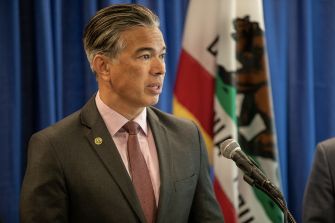
Photo Source: California Department of Justice, Office of the Attorney General Media Library
A coalition of 12 state attorneys general and the Writers Guild of America is urging a federal judge to reject Paramount Skydance’s demand for a $1.88 billion bond as they seek to block its $110 billion acquisition of Warner Bros. Discovery on antitrust grounds.
In a filing Monday, the challengers argued that the bond would force taxpayers and nonprofit labor unions to shoulder costs Paramount voluntarily assumed when it negotiated the Warner Bros. Discovery deal.
Under its merger agreement with Warner Bros. Discovery, Paramount must begin making additional payments to Warner Bros. Discovery shareholders if the transaction does not close by September 30. The payments, known as ticking fees, begin October 1 at roughly $7 million a day.
Paramount estimates those fees could reach about $1.3 billion by the time a March 2027 trial concludes and post-trial briefs are submitted in April. If the merger remains unfinished through June 1, the company says the payments could total approximately $1.7 billion, along with another $190 million in financing costs.
Paramount wants U.S. District Judge Araceli Martínez-Olguín to require the states and the WGA to provide $1.88 billion in financial security against those potential losses.
The challengers argue the requested bond would make them responsible for costs Paramount accepted when it negotiated the merger and later agreed not to close the transaction while the antitrust litigation proceeds.
“Paramount now wishes to offload its responsibility,” California Attorney General Rob Bonta argued in the filing.
Paramount counters that the plaintiffs should not receive a “free pass” from losses caused by delaying the merger if their challenges ultimately fail.
The request is governed by Rule 65 of the Federal Rules of Civil Procedure. When a court restrains a party through a temporary restraining order or preliminary injunctionA preliminary injunction is a temporary court order issued before a case is finally decided that requires a party to take or stop an action while the litigation continues. Federal courts generally consider the likelihood of success, irreparable harm, the balance of equities, and the public interest before granting one.Read more →, the judge can require the party seeking that relief to provide financial security for certain costs and damages if the restriction is later found to have been improper.
The rule gives judges discretion over the amount of security required, including whether a bond should be imposed at all.
Martínez-Olguín has already considered that question once. When she temporarily blocked the merger in July, she waived the security requirement for the states, citing their role in enforcing antitrust laws in the public interest.
Paramount is now asking her to revisit the issue after the parties agreed to bypass a preliminary injunction fight and proceed toward a trial on whether the merger violates federal antitrust law.
The companies have agreed not to close the transaction until five days after the court resolves the challenges or June 1, 2027, whichever comes first.
California, Arizona, Colorado, Connecticut, Massachusetts, Minnesota, Nevada, New Jersey, New Mexico, New York, Oregon and Washington sued in July to stop the merger under Section 7 of the Clayton Act.
The states allege the merger would violate Section 7 by substantially reducing competition in parts of the film and television industries, including by giving the combined company greater power to raise prices.
The Writers Guild of America West and Writers Guild of America East filed a separate challenge focused in part on competition for writers and other creative workers.
Paramount denies the transaction violates antitrust law and argues the combined company would be better positioned to compete with larger entertainment and technology companies. The Justice Department has cleared the deal, but state attorneys general retain authority to bring their own challenges under federal antitrust law.
Martínez-Olguín is scheduled to hear Paramount’s bond request on September 24, less than a week before the approximately $7 million daily ticking fee is set to begin October 1. The antitrust trial is scheduled for March 2, 2027.
Share This Article
If you found this article insightful, consider sharing it with your network.
Alexandra Agraz is a former Diplomatic Aide with firsthand experience in facilitating high-level international events, including the signing of critical economic and political agreements between the United States and Mexico. She holds dual associate degrees in Humanities, Social and Political Sciences, and Film, blending a diverse academic background in diplomacy, culture, and storytelling. This unique combination enables her to provide nuanced perspectives on global relations and cultural narratives.
Paramount Skydance’s $110 billion acquisition of Warner Bros. Discovery has been cleared to close after a federal judge approved a settlement with 12 states and lifted the court order that had blocked the companies from completing the merger.Paramount and Warner Bros. Discovery said Wednesday, September 30, 2026, that they expect...
Read
More »
Paramount has completed its acquisition of Warner Bros. Discovery, closing an $81 billion takeover valued at about $111 billion including debt and combining two of Hollywood’s oldest studios with HBO, CNN, CBS, and some of the entertainment industry’s largest franchises.The transaction closed October 6, 2026, after Paramount cleared federal antitrust...
Read
More »
Paramount executives have told California and Los Angeles officials that the company is “deadly serious” about moving its headquarters out of the state as its $110 billion Warner Bros. Discovery merger remains locked in an antitrust fight.Los Angeles Mayor Karen Bass and California Attorney General Rob Bonta are among those...
Read
More »
Paramount’s $110 billion acquisition of Warner Bros. Discovery has cleared its biggest remaining legal obstacles after the company reached settlements with 12 states and the Writers Guild of America, putting the Hollywood megadeal on a path toward closing after months of antitrust litigation.The agreement with California and 11 other states...
Read
More »
Paramount Skydance says California Attorney General Rob Bonta contradicted his own legal position in television interviews as the company seeks a $1.88 billion bond in the fight over its $110 billion acquisition of Warner Bros. Discovery.In a court filing Tuesday, Paramount pointed to interviews in which Bonta described the companies’...
Read
More »
We use cookies and similar technologies to help our website function, understand how visitors use our site, and improve your experience. Some cookies are necessary for the website to operate, while others may be used for analytics or advertising.