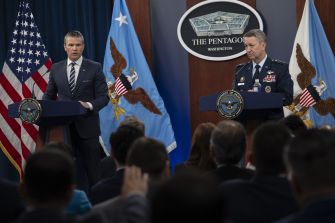
The Pentagon has ordered mandatory testosterone testing for male active-duty and reserve service members age 30 and older, putting into effect a military-wide health policy announced by Defense Secretary Pete Hegseth in July.
The Defense Health Agency issued clinical guidelines Wednesday requiring the testing as part of troops’ periodic health assessments. Male service members 30 and older will undergo testosterone blood tests, while those under 30 may request testing or be screened when clinicians identify signs of a possible deficiency.
The requirement does not make testosterone treatment mandatory. Service members diagnosed with hypogonadism, commonly known as low testosterone, may undergo additional testing and receive treatment when medically appropriate. Hegseth said when he announced the program that testosterone replacement therapy would remain voluntary.
The guidance creates a separate screening process for female service members. Women will be evaluated for symptoms that may indicate hormonal problems, including fatigue and disrupted menstrual cycles, but routine testosterone blood testing is not required.
For some postmenopausal women, the guidelines also address when testosterone may be prescribed for unusually low sexual desire. No testosterone product is currently approved by the Food and Drug Administration for use in women, meaning such prescriptions would be considered off-label.
Off-label prescribing is permitted in the United States when a medical provider determines an FDA-approved drug is appropriate for a patient. The designation means the FDA has not approved the drug as safe and effective for that specific use or patient population.
The Pentagon has framed the screening program as a military readiness measure. Its guidance describes testosterone as an important biological marker linked to physical strength, bone density, aerobic fitness, mood and cardiovascular health.
The department said the policy is intended to identify hormonal problems earlier and establish consistent screening and treatment standards across the military health system.
Hegseth announced the initiative July 15, arguing that maintaining hormone health could improve the long-term performance and resilience of service members. He said the program was aimed at restoring natural hormone levels rather than enhancing troops’ performance beyond normal levels.
The policy has also raised questions among medical experts about the value of testing large numbers of people who may have no symptoms. The American Urological Association recommends that testosterone deficiency in men generally be diagnosed when low testosterone measurements are accompanied by symptoms or signs of the condition. Its guidelines also call for two separate early-morning testosterone measurements before a diagnosis is made.
Military personnel may face conditions that can affect hormone levels. Researchers have studied decreased testosterone and other hormonal changes among troops exposed to prolonged stress, sleep disruption, traumatic brain injuries and blast exposure, particularly in special operations forces.
Army Maj. Theodore Crisostomo-Wynne, a urologist at Madigan Army Medical Center, told an FDA panel last year that the military’s high operational tempo and sustained stress can reduce testosterone levels temporarily and over longer periods.
The Pentagon’s rollout comes as federal regulators are also examining testosterone treatment more broadly. The FDA is scheduled to hold a public workshop Sept. 17 on testosterone use in menopausal women, including its potential benefits, risks and gaps in existing research.
The military guidance took effect immediately and directs the services and military medical providers to follow standardized screening and treatment procedures across the Defense Health Agency.