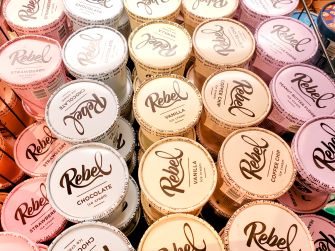
Rebel Creamery has filed for Chapter 11 bankruptcy protection in Utah while challenging a federal judgment requiring the ice cream maker to turn over nearly $23.8 million in profits to rival Van Leeuwen over the appearance of its pint packaging.
The Utah-based company filed its bankruptcy petition Aug. 14, two days after filing a notice of appeal in the trademark case. Rebel reported approximately $13.78 million in assets and $23.85 million in liabilities, according to court filings. Van Leeuwen is listed as an unsecured creditor holding a disputed $23.785 million claim tied to the judgment, which accounts for nearly all of Rebel's unsecured liabilities listed at fixed amounts.
Rebel's bankruptcy filing follows a July 16 ruling by U.S. District Judge Eric Komitee in Brooklyn, who found, after a bench trial, that the company intentionally infringed and diluted Van Leeuwen's trade dress. Komitee ordered Rebel to stop selling ice cream in packaging likely to be confused with Van Leeuwen's, redesign its pints, and surrender $23.785 million in profits from sales tied to the infringing packaging.
Van Leeuwen sued Rebel in 2021 over similarities between the companies' pint designs. Its claims centered on an overall combination of monochromatic pastel cartons, matching lids, black script lettering, and a minimalist appearance. Rebel argued that the individual features were common in food packaging and maintained that its founders had developed their design independently.
Federal trademark law can protect the overall look of a product or its packaging, known as trade dress, when consumers associate the design with a particular company. Protection can cover a combination of features, including colors, lettering, and layout, even when no single feature belongs exclusively to one brand. Courts look at the overall appearance and whether another company's use is likely to confuse consumers about who made or sold the product.
Komitee found Van Leeuwen's packaging met that standard and concluded that Rebel's pints were sufficiently similar to create a likelihood of confusion. His ruling also pointed to evidence that consumers and people within the industry had confused the two brands.
Rebel denied intentionally copying Van Leeuwen's design and argued during the litigation that similarities between the cartons were coincidental. Komitee rejected the company's account of how its packaging was developed and found that Rebel had acted in bad faith, according to the court's ruling.
The $23.785 million award was based on Rebel's profits rather than an equivalent amount Van Leeuwen claimed to have lost. Federal trademark law can allow courts to require a company found liable for infringement to surrender profits connected to the unlawful use, a remedy known as disgorgement.
Van Leeuwen sought approximately $36.4 million in Rebel's profits. Komitee reduced the requested amount by 33 percent after finding that part of Rebel's sales could be attributed to consumer demand for keto and other health-focused ice cream rather than the disputed packaging. The reduction left Van Leeuwen with a $23.785 million profits award.
The size of the judgment quickly became significant to Rebel's financial position. Bankruptcy filings show the Van Leeuwen claim is larger than Rebel's reported assets and represents the overwhelming majority of its listed fixed unsecured debt. Rebel has classified the judgment as disputed because the company is appealing the ruling.
Chapter 11 allows businesses to continue operating while restructuring their debts under bankruptcy court supervision. A bankruptcy filing also generally pauses collection efforts involving existing debts, placing Van Leeuwen's judgment within the bankruptcy process while Rebel continues to challenge the underlying ruling.
Rebel filed its notice of appeal Aug. 12 in the federal trade dress case in New York. Two days later, the company sought Chapter 11 protection in the U.S. Bankruptcy Court for the District of Utah. The appeal of the $23.785 million judgment remains pending, while Rebel's bankruptcy case is proceeding separately in Utah federal court.