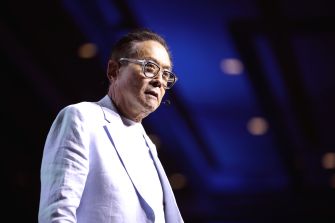
Robert Kiyosaki, the author of Rich Dad Poor Dad, says he has about $1.2 billion in debt and wants even more, arguing that borrowing to buy income-producing real estate is one of the ways he builds wealth. But most of that $1.2 billion is not debt he personally owes.
Kim Kiyosaki, his former wife and longtime business partner, said the figure represents debt held across real estate investments involving roughly 1,500 apartment units owned with partners. She said Kiyosaki’s individual share is substantially smaller.
Kiyosaki, 79, has made the $1.2 billion figure a recurring part of his financial message. In June, he devoted an episode of his Rich Dad Radio Show to 10 ways he says he uses debt to build wealth, promoting it with the declaration that he owes $1.2 billion “on purpose.”
The claim is consistent with an investment philosophy Kiyosaki has promoted for decades. The 1997 bestseller Rich Dad Poor Dad, which has sold more than 44 million copies, helped build his career around the idea that wealth comes from acquiring assets that produce income.
Real estate is central to that approach. An investor can borrow money to buy an apartment building, collect rent, and use part of that income to cover the mortgage and other expenses. If the property gains value, the owner may also be able to refinance and borrow against the additional equity without selling it.
Kiyosaki has said his individual investments are placed in limited liability companies, or LLCs. An LLC is legally separate from its owners and generally shields them from personal responsibility for company debts.
A mortgage taken out by an LLC to buy an apartment complex is therefore not automatically a personal obligation of each investor who owns part of the company. An investor can still become personally responsible for debt by guaranteeing a loan, and courts can disregard an LLC’s separate status in limited circumstances.
Kiyosaki has not publicly disclosed the terms of the individual loans behind the real estate portfolio or how much of the debt he has personally guaranteed. His personal liability for the investments has therefore not been publicly established.
Borrowing also plays a role in the tax strategy Kiyosaki promotes. Loan proceeds generally are not considered taxable income because the money must be repaid.
An owner whose property has increased in value can potentially borrow against that equity without selling the asset and realizing a taxable gain. Owners of rental real estate may also qualify for mortgage interest deductions and depreciation, subject to federal tax rules and limitations.
The strategy depends on the properties producing enough income to support the debt. Falling rents, vacancies, higher financing costs, or declining property values can make heavily leveraged investments more difficult to sustain, while debt can increase losses when an investment underperforms.
Kiyosaki has previously dealt with a business failure in which the separation between a company and its owners became legally significant.
Rich Global LLC, a company connected to Kiyosaki’s financial education business, filed for Chapter 7 bankruptcy in 2012 after litigation with Learning Annex resulted in a judgment of more than $23 million. Federal bankruptcy records identify Rich Global LLC as the debtor, not Kiyosaki personally.
A bankruptcy court later said Rich Dad Operating Company was Rich Global’s sole member and that Robert and Kim Kiyosaki owned Rich Dad. The dispute involved a different company and circumstances from his current real estate investments.
Kiyosaki continues to describe debt as a wealth-building tool when borrowed money is used to acquire assets that generate income. His exact personal exposure to the real estate debt has not been disclosed, but Kim Kiyosaki’s account places the widely cited $1.2 billion figure across investments held with other partners rather than solely on Robert Kiyosaki’s personal balance sheet.