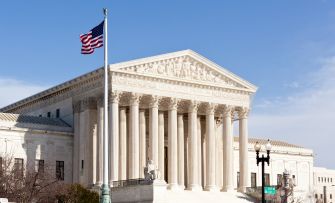
The Supreme Court has allowed California to use its newly approved congressional map for the 2026 midterm elections, rejecting an emergency request to block the districts and clearing the way for the state to proceed under lines drawn last year. The decision keeps the voter-approved map in place as Democrats and Republicans continue a nationwide legal fight over redistricting and control of the U.S. House of Representatives.
In a brief, unsigned order issued Wednesday, the Supreme Court declined to intervene before the election, leaving intact a lower federal court ruling that rejected constitutional challenges to California’s plan. The request was filed by the California Republican Party, which argued that the map was unlawfully driven by racial considerations rather than political goals. The lower court disagreed, and the justices declined to halt the map on an emergency basis.
Congressional maps are redrawn every ten years following the national census to account for population changes and maintain equal representation. California holds the largest delegation in the House with 52 seats, giving its district lines particular weight in closely divided election cycles. While redistricting has long been part of election administration, recent cycles have seen increased litigation as states controlled by one party seek to strengthen their electoral position through map design.
California’s plan was adopted after Texas enacted a Republican-backed congressional map aimed at bolstering GOP prospects in that state. President Donald Trump publicly supported the Texas effort, arguing it would help Republicans preserve their narrow House majority. The Supreme Court previously allowed Texas to proceed with its revised districts, a ruling that set the stage for California’s response.
When the Court addressed the Texas map earlier this term, it acknowledged the openly political nature of the redistricting dispute. The justices noted that Texas acted first and that California followed with its own plan to counterbalance those gains. Justice Samuel Alito, joined by Justices Clarence Thomas and Neil Gorsuch, wrote separately that partisan advantage was the primary motivation behind both states’ actions.
That framing is central to the legal outcome. The Supreme Court has ruled that claims of partisan gerrymandering are not reviewable by federal courts. In a 2019 decision, the Court concluded that there is no workable legal standard for judges to determine how much political advantage is too much, placing such disputes beyond federal constitutional review.
Racial gerrymandering claims are treated differently. The Constitution prohibits race from being the predominant factor in drawing congressional districts unless it is narrowly tailored to comply with federal voting rights laws. Courts evaluate whether race outweighs traditional redistricting considerations such as geography, population balance, and political boundaries. In California’s case, lower courts concluded that political strategy, not racial classification, drove the map’s design. That determination placed the dispute within a category of cases that federal courts have said they cannot resolve.
Timing also weighed against intervention. Courts are generally reluctant to change election rules close to an election, citing concerns about voter confusion and administrative disruption. Emergency requests face a high bar when lower courts have already ruled, and election preparations are underway.
With both the Texas and California maps allowed to stand, the immediate partisan effects may be limited. Democrats have said California’s districts are intended to offset Republican gains elsewhere, meaning the two states’ changes could largely neutralize each other in terms of net House seats.
Legal challenges over congressional maps continue in other states. In New York, Republican Representative Nicole Malliotakis and GOP members of the state elections board are appealing a court order requiring a new map after a judge found that an existing district unlawfully diluted the combined voting power of Black and Latino communities. In Utah, two Republican House members have filed a federal lawsuit challenging a court-selected map they argue violates the Constitution. In Virginia, a judge has blocked a proposed constitutional amendment on redistricting, ruling that state lawmakers advanced it through an improper process, a decision Democrats are appealing.
Redistricting remains before the Supreme Court this term in a challenge to Louisiana’s congressional map involving the application of the Voting Rights Act of 1965. The dispute centers on whether the state’s map provides minority voters with an equal opportunity to elect candidates of their choice. The justices have heard arguments but have not yet issued a decision.
California’s congressional districts will remain in effect for the 2026 midterm elections.