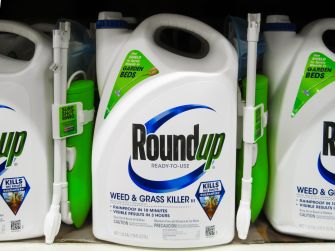
The U.S. Supreme Court ruled Thursday that federal pesticide law bars a Missouri man’s failure-to-warn claim against Monsanto over Roundup, a decision that gives the company a major win in litigation over cancer warnings on the widely used weed killer.
In a 7-2 decision, the Court reversed a Missouri appeals court ruling that had allowed John Durnell’s claim to stand. Durnell alleged that he used Roundup products for about 20 years and developed non-Hodgkin’s lymphoma because Monsanto failed to include a cancer warning on the product’s label.
A Missouri jury had awarded Durnell more than $1 million on the failure-to-warn theory. Monsanto argued that the claim was blocked by the Federal Insecticide, Fungicide, and Rodenticide Act, known as FIFRA, because the Environmental Protection Agency had approved Roundup’s label without a cancer warning.
Justice Brett Kavanaugh wrote the majority opinion, joined by Chief Justice John Roberts and Justices Clarence Thomas, Samuel Alito, Sonia Sotomayor, Elena Kagan and Amy Coney Barrett. Justice Ketanji Brown Jackson dissented, joined by Justice Neil Gorsuch.
The ruling does not decide whether Roundup causes cancer. Instead, the Court answered a legal question about whether a state-law warning claim can go forward when the warning sought by the injured user is not part of the label approved under federal pesticide law.
Monsanto, now a subsidiary of Bayer AG, manufactures and distributes Roundup, a glyphosate-based herbicide used to control weeds. EPA first registered glyphosate-based pesticides in 1974 and approved Roundup labeling without a cancer warning.
According to the Court, EPA has repeatedly reviewed glyphosate and has repeatedly concluded that the chemical is not likely to cause cancer. The agency has not required glyphosate-based pesticides such as Roundup to carry a cancer warning.
Durnell’s lawsuit centered on failure to warn, a product liability claim that alleges a company sold a product without giving users adequate notice of a serious risk. His claim turned on whether Monsanto should have warned Roundup users about an alleged cancer risk, even though EPA had approved the product’s label without that warning.
Monsanto’s defense relied on preemption, the rule that federal law can override state law when the two impose conflicting duties. The company argued that FIFRA gave EPA control over pesticide labeling and that Missouri law could not require a cancer warning that EPA had not required on Roundup’s label.
FIFRA gives EPA authority over pesticide registration and labeling. The law also contains a provision aimed at label uniformity, barring states from imposing pesticide labeling or packaging requirements that are “in addition to or different from” requirements under federal law.
The majority said Durnell’s claim would do exactly that. Because his lawsuit claimed Monsanto should have added a cancer warning to Roundup, the Court said a verdict in his favor would impose a state labeling requirement different from the label EPA approved.
Kavanaugh wrote that after EPA approves a pesticide label, the manufacturer is legally required to use that label unless EPA approves or requires a change. The majority said Monsanto was required to sell Roundup with the EPA-approved label, which did not include a cancer warning, and that Missouri law could not require a different warning through a tort claim.
The Court also said state tort duties can count as labeling requirements. A jury verdict in a warning case may not rewrite a label directly, but it can pressure or require a company to change future labeling to avoid liability. For the majority, that made Durnell’s claim a state-law labeling requirement that conflicted with FIFRA’s uniform-labeling rule.
Jackson’s dissent took a different view of FIFRA. She argued that Durnell’s claim did not add a new requirement because federal law itself bars “misbranded” pesticides, including pesticides with labels that lack warnings needed to protect health and the environment.
Under that view, Durnell’s Missouri claim was parallel to FIFRA, not different from it. Jackson wrote that EPA’s registration of a pesticide is not conclusive proof that a label complies with the law, and she argued that the majority gave EPA label approval more preemptive force than FIFRA allows.
The dissent also said the ruling leaves Durnell without a remedy for the harm he alleged after a jury agreed with his warning claim. Jackson noted that several state and federal courts had rejected Monsanto’s preemption argument before the Supreme Court took up the case.
Thomas joined the majority opinion in full but wrote separately to raise broader constitutional concerns about FIFRA and the scope of federal regulatory power. His concurrence did not change the Court’s holding.
The decision gives pesticide manufacturers a stronger defense in lawsuits that challenge warnings omitted from EPA-approved labels. The ruling is likely to carry the most weight in claims that seek to impose a state-law warning different from the label approved under FIFRA.
The Supreme Court reversed the judgment of the Missouri Court of Appeals.