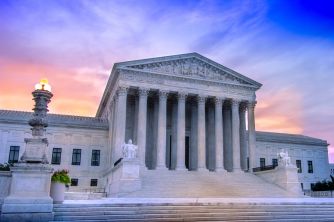
The U.S. Supreme Court on Wednesday overturned a $1 billion verdict against Cox Communications, ruling that internet service providers cannot be held liable for copyright infringement committed by users on their networks based only on knowledge of that activity.
The ruling reverses a lower court decision that had allowed the case to proceed on the idea that continuing to provide internet service to subscribers linked to repeated violations could make Cox legally responsible under federal copyright law.
More than 50 record labels and music publishers, including Sony Music Entertainment, Warner Music Group, and Universal Music Group, sued Cox in 2018. They accused the company, a major U.S. internet provider serving millions of subscribers, of failing to act on piracy occurring through its network.
The companies said those users illegally shared more than 10,000 copyrighted works through peer-to-peer services. To track that activity, they hired MarkMonitor, a monitoring company that identifies alleged infringement and links it to specific IP addresses. Over roughly two years, MarkMonitor sent Cox more than 160,000 notices tied to alleged violations.
The labels argued that Cox did not take sufficient steps in response, while Cox maintained a system of warnings, suspensions, and account terminations.
After a federal trial in Virginia in 2019, a jury found Cox liable for contributory and vicarious copyright infringement and awarded $1 billion in statutory damages. Cox appealed the verdict.
The U.S. Court of Appeals for the Fourth Circuit later set aside the vicarious liability finding but left the contributory liability ruling in place and ordered a new trial on damages. Cox then asked the Supreme Court to review whether that theory could stand.
Writing for the majority, Justice Clarence Thomas said the Copyright Act does not automatically make a company responsible for the actions of others and limits when secondary copyright liability applies.
Under copyright law, contributory infringement is one form of secondary liability. It allows a company to be held responsible for another party’s infringement, but only in certain situations. Courts require evidence that the company encouraged the conduct or provided a product or service that is mainly used for unlawful activity.
The Court said that intent can be shown in two ways. A company may be liable if it actively encourages infringement, such as promoting a product for unlawful use. It may also be liable if it offers a service designed mainly for infringement and lacking meaningful lawful uses. The Court found neither theory applied to Cox.
Applying that standard, the Court said the labels had not shown that Cox encouraged unlawful activity or that its internet service was built for unlawful use. The opinion also said that a provider’s knowledge that some users are misusing a service, without more, is not enough to establish contributory infringement.
The justices also addressed the Digital Millennium Copyright Act, which protects internet providers from certain copyright claims if they adopt policies for dealing with repeat infringers. The music companies argued that allowing providers to avoid responsibility would weaken that framework. The Court said the law creates a defense for qualifying companies but does not impose liability when those requirements are not met, and that the Fourth Circuit applied too broad a standard by treating knowledge of infringement and failure to act as enough to establish responsibility.
Record labels and copyright owners have increasingly targeted internet providers as large-scale file sharing has made it difficult to pursue individual users. Service providers, in turn, have argued that they cannot identify specific users behind an internet connection or control how those connections are used, particularly where multiple people share a single account.
The Supreme Court reversed the Fourth Circuit’s contributory liability ruling and returned the case to the lower courts.