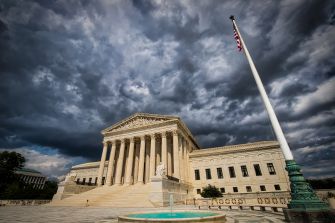
The U.S. Supreme Court ruled that Michigan’s lawsuit seeking to shut down part of the Line 5 pipeline must stay in state court, finding that Enbridge Energy missed the deadline to move the case to federal court.
In a unanimous decision written by Sonia Sotomayor, the court said the company waited too long to try to move the case. The decision keeps the lawsuit filed by Michigan Attorney General Dana Nessel before a state judge, where it has been pending since 2019.
The case involves a 4.5-mile stretch of Enbridge’s Line 5 that runs beneath the Straits of Mackinac, a waterway connecting Lakes Michigan and Huron. The line, in operation since 1953, carries crude oil and natural gas liquids between Wisconsin and Ontario.
Nessel’s lawsuit seeks to void the easement that allows the company to operate that underwater segment, arguing the line no longer has a valid legal right to occupy the lakebed. A state judge issued a restraining order in 2020, though the company was allowed to continue operating after meeting certain safety conditions. Courts use these orders to limit activity while a case moves forward, often to prevent harm before a final ruling.
Enbridge later tried to move the case to federal court, arguing the case involves cross-border energy transport. Enbridge said that brings the case under federal law tied to international commerce. But the U.S. Court of Appeals for the Sixth Circuit ruled in 2024 that the company missed a 30-day deadline required to transfer the case.
Federal law allows a company to move a case from state court to federal court, but only within a limited time window that begins when the lawsuit is served. If that deadline passes, the case must stay in the original court. The Supreme Court found that Enbridge did not meet that requirement, leaving the case where it was filed.
The lawsuit also involves an easement, a legal agreement that allows a company to use land or property owned by someone else for a specific purpose. Michigan argues that the agreement for Line 5 can be revoked because of safety concerns and alleged violations of its terms. Enbridge disputes that and maintains it still has the right to operate the line.
States regulate land use and environmental risks within their borders, while federal agencies oversee pipeline safety. The overlap has led to parallel legal fights over Line 5.
Concerns about the condition of the line have grown in recent years. Company engineers disclosed that gaps in the protective coating were known as early as 2014. A vessel anchor strike in 2018 damaged the line, increasing the risk of a rupture in the straits.
Michigan separately moved to revoke the easement in 2020, but Enbridge challenged that action in federal court and obtained a ruling blocking the shutdown. Governor Gretchen Whitmer appealed that decision, but the Supreme Court declined to allow the appeal to proceed earlier this year.
It is not clear how that federal ruling will affect the state case. Enbridge has said a federal judge determined that pipeline safety oversight falls under federal regulators, who have not ordered the line to close.
Nessel, in a statement, said the Supreme Court’s decision confirms that the case belongs in state court, where Michigan has argued that Line 5 does not have a legal right to remain beneath the straits.
In Wisconsin, a federal judge ordered Enbridge to shut down and reroute a portion of Line 5 that crosses land belonging to the Bad River Band of Lake Superior. The company has appealed that order while also moving forward with a reroute. Environmental groups and tribal authorities have filed a separate state lawsuit challenging that project, arguing regulators did not fully account for environmental risks.
Enbridge is also pursuing plans to build a protective tunnel around the pipeline beneath the straits, a project that has received approval from state regulators but still requires additional permits from federal and state agencies. That proposal is facing its own legal challenge in Michigan courts.