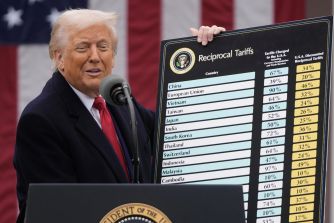
The Supreme Court on Friday ruled that President Donald Trump acted beyond the authority granted by Congress when he imposed global tariffs under a federal emergency powers law, striking down the duties in a 6 to 3 decision. The ruling turns on a constitutional principle: the power to tax rests with Congress.
At issue were tariffs imposed under the International Emergency Economic Powers Act, a 1977 statute that allows a president to regulate certain economic transactions during a declared national emergency. Invoking that law, Trump announced “reciprocal” tariffs in April 2025 on most countries, raising duties as high as 50 percent on some trading partners and as high as 145 percent on imports from China. The administration said the measures were intended to address trade deficits and drug trafficking concerns.
Since its enactment, IEEPA has most often been used to impose economic sanctions on foreign governments, organizations, or individuals. It had not previously been used to establish broad tariffs on imports. The Court noted that history is in assessing the scope of authority Congress granted under the statute.
Writing for the majority, Chief Justice John Roberts stated that the Constitution assigns the taxing power to Congress. “The Framers did not vest any part of the taxing power in the Executive Branch,” Roberts wrote. The Court concluded that IEEPA does not authorize a president to impose tariffs of unlimited scope or duration.
Tariffs are legally treated as taxes on imported goods. Article I of the Constitution gives Congress the authority to lay and collect taxes, including duties on imports. Congress may delegate authority to the executive branch, but courts require clear language when that delegation carries major economic consequences. When a president claims authority that reshapes a large segment of the national economy, judges examine the statute closely to determine whether Congress clearly granted that power.
That requirement is often described as the major questions doctrine. The principle holds that when a president claims power over an issue of vast economic or political significance, Congress must have clearly authorized that action. The Court rejected the argument that emergency statutes operate outside that rule. Although IEEPA permits a president to “regulate” importation during emergencies, the majority found that the term does not include the power to impose tariffs.
Justice Amy Coney Barrett and Justice Neil Gorsuch joined Roberts and the Court’s three liberal justices in the majority. Justices Clarence Thomas, Samuel Alito and Brett Kavanaugh dissented. Kavanaugh wrote that the tariffs were lawful and noted that the Court did not address how the government should handle the billions of dollars already collected.
Justice Elena Kagan, joined by the other two liberal justices, agreed that the statute does not authorize tariffs. She wrote that ordinary rules of statutory interpretation were sufficient to resolve the case without relying on the major questions doctrine.
The administration argued that tariffs fall within the president’s foreign affairs authority, an area where courts traditionally defer to the executive branch. Roberts rejected that position, writing that foreign policy implications do not alter the Constitution’s allocation of taxing power. Even in matters touching international trade, the authority to impose taxes remains with Congress unless clearly reassigned.
The dispute began with lawsuits filed by small businesses and a coalition of states that argued the emergency powers law does not mention tariffs and does not grant authority to impose what amounts to a new tax. The challengers included companies selling products ranging from wine to educational toys, as well as large importers seeking to preserve their ability to pursue refunds.
Federal data show that more than $130 billion in tariff revenue had been collected under the challenged measures as of December. The Court did not decide whether companies that paid the duties are entitled to refunds. When goods enter the country, Customs finalizes the tariff amount through a process known as liquidation. Once finalized, recovering those payments can be legally complex. Several importers have filed separate actions seeking repayment.
Trial courts and appellate panels reviewing the emergency tariffs uniformly concluded that the statute did not authorize them, though those rulings were temporarily paused while appeals proceeded. The Supreme Court’s decision resolves the central constitutional question but leaves refund disputes to be addressed in further proceedings.
The ruling does not prevent a president from imposing tariffs under other trade statutes enacted by Congress. Those laws include defined procedures and limits set by lawmakers. Section 232 of the Trade Expansion Act of 1962, for example, permits tariffs for national security reasons following an investigation by the Commerce Department. That law sets out procedural requirements and limits not found in IEEPA.
The case now returns to lower courts, where refund disputes remain pending.