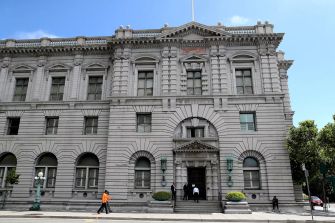
Photo Source: A view of the U.S. 9th Circuit Court of Appeals. (Justin Sullivan / Getty Images)
The battle over the “gig economy” continues to rage as the State of California seeks rehearing or review of a Ninth Circuit Court of Appeals decision that found that Assembly Bill 5 may have violated the rights of Uber, Postmates, and their drivers.
California Assembly Bill 5 (AB 5) was originally passed in 2019 and was set to go into effect in 2020. The bill, backed by labor unions, was intended to clarify the definitions of “independent contractor” and “employee.” Lawmakers aimed to curb the practice of over-classifying workers as contractors in order to avoid being subject to minimum wage rules and other labor laws.
AB 5 codified into law a three-pronged test for determining whether a worker was an employee or an independent contractor, a test established by a prior Supreme Court ruling. In effect, the test would cause many “gig workers” to be classified as employees, entitled to labor law protections such as minimum wage, healthcare, paid time off, and other benefits. The law was targeted at companies that hired gig workers in large numbers, such as Uber, Lyft, DoorDash, and Postmates.
California law presumes that a worker is an employee earning wages rather than an independent contractor. In general, workers are considered employees unless they satisfy all three prongs of the ABC test.
— Richard Koss, Employment Attorney
Richard Koss, a California labor and employment law attorney based in the San Francisco Bay Area, explains the “ABC” test adopted in AB 5. “California law presumes that a worker is an employee earning wages rather than an independent contractor,” he says. “In general,” Koss explains, “workers are considered employees unless they satisfy all three prongs of the ABC test.” These three prongs are as follows:
A. The person is free from the control and direction of the hiring entity in connection with the performance of the work,
B. The person performs work that is outside the usual course of the hiring entity’s business,
C. The person is customarily engaged in an independently established trade, occupation, or business.
AB 5 places the responsibility on the hiring entity to demonstrate that all three parts of the above test are met in order to classify a worker as an independent contractor.
The law was met with heavy resistance from the jump. The companies argued that AB5 would render their whole business model untenable via skyrocketing costs and limited flexibility for workers. Many gig workers agreed, worried that classification as an employee would reduce the freedom inherent in app-based work. On the other hand, labor unions and other advocates contend the law is necessary because the absence of clarity has allowed employers to effectively rob workers of proper wages and benefits by misclassifying them as independent contracts.
A preliminary injunction prevented the law from going into effect on January 1, 2020. Later in 2020, California voters approved Proposition 22, a voter initiative backed by Uber, Lyft, and Doordash, which legally designates app-based workers as independent contractors regardless of AB 5. Even California legislators passed another law in 2020 excluding certain job categories from AB 5’s purview.
The fight over AB 5 continued despite those later-imposed limitations. In March 2023, a three-judge panel of the Ninth Circuit unanimously ruled that Uber, Postmates, and their drivers had plausibly alleged that AB 5 violated their rights under the Equal Protection Clause of the Constitution. The court found plausible the plaintiffs’ arguments that the law illegally targeted specific companies, including Uber and Lyft, while granting a number of exceptions for certain industries and not others. Around the same time, a California state appeals court upheld the constitutionality of Prop 22, another victory for the gig economy.
The State of California is now asking the Ninth Circuit to take another look at the AB 5 case. They argue the appeals court should review its decision or rehear the case “en banc,” meaning the entire swath of Ninth Circuit judges would consider the case.
Attorneys general for 15 states across the country filed an amicus “friend of the court” brief supporting the request for en banc review by the full Ninth Circuit. The amicus brief highlights not only that the stakes of a final AB 5 ruling extend beyond California’s borders, but also the stark political divide on the issue. The states, nearly all controlled by Democratic governors, are asking the appeals court to “correct the mistaken and harmful panel decision.”
At the same time, the Department of Labor is considering a proposed rule that would clarify the independent contractor test at the federal level. Julie Su, President Biden’s nominee for the next Secretary of the Department of Labor, is already facing pressure from all sides regarding AB 5 and the independent contractor test. Concern over the issue has significantly raised the stakes for her confirmation.
Attorney Koss explains that California’s labor laws are generally better for employees than federal rules. “In most instances, the California employees get the better of the two rules,” he says. However, Koss points out that due to the legal doctrine known as “preemption,” a new federal rule could invalidate the California law to the extent the two are contradictory.
How the courts eventually rule on AB 5 will have national implications for how courts and regulators define an employee vs. a legitimate independent contractor.
Share This Article
If you found this article insightful, consider sharing it with your network.
Christopher Hazlehurst is a graduate of Columbia Law School, where he also served as Editor of the Columbia Law Review. Throughout his legal career, he has navigated a diverse array of intricate commercial litigation and investigations involving white-collar crime and regulatory issues. Simultaneously, he maintains a strong commitment to public interest cases nationwide. Presently, he holds a license to practice law in California.
The US Supreme Court justices declined to hear an appeal by Uber and Lyft, which are being sued by the California Labor Commission for committing wage theft and violating California labor laws. The justices did not share any comments on why they denied the ride-sharing platforms’ writ of certiorari. This...
Read
More »
Ruling that a new California labor code section “regulates economic activity rather than speech,” the Ninth Circuit rejected First Amendment and Equal Protection challenges to the 2020 amendments to AB 5, a law that makes some freelance journalists employees instead of independent contractors.
Writing for a unanimous three-judge panel, Circuit...
Read
More »
California has had a storied relationship with arbitration. One of the U.S. Supreme Court’s most significant recent opinions on arbitration, AT & T Mobility v. Concepcion, stemmed from a lawsuit filed in California. The state’s attempts to limit the power of mandatory arbitration agreements in both employment and consumer contracts...
Read
More »
California’s efforts to improve working conditions in the fast-food industry have been met with aggressive resistance. In late December, a county judge blocked the state from implementing a landmark new law aimed at setting a higher minimum wage for quick service workers, pending the results of a voter referendum. With...
Read
More »
Much ink has been spilled about Prop 22, California’s 2020 ballot initiative that made it clear gig workers such as drivers for companies like Uber, Lyft and DoorDash are not employees of the companies they work for. They are now officially independent contractors and therefore not entitled to employee benefits...
Read
More »