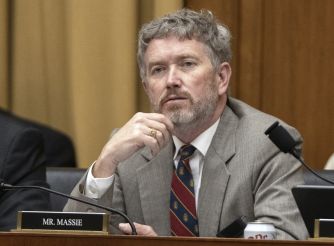
Rep. Thomas Massie, a Kentucky Republican, named 14 people on the House floor Monday as Jeffrey Epstein “co-conspirators” who he said should be investigated and prosecuted. He also launched a discharge petition to force a House vote on the Epstein Files Transparency Act II.
The bill would expand access to federal Epstein records for victims, state prosecutors and members of Congress and allow new court challenges over material the Justice Department has withheld or redacted.
During his Aug. 31 floor speech, Massie named Jes Staley, Leon Black, Les Wexner, David Copperfield, Lapo Elkann, Tom Pritzker, Glenn Dubin, Frédéric Fekkai, Edoardo Teodorani, Jean-Luc Brunel, Daniel Siad, Ramsey Elkholy, Andrew Mountbatten-Windsor, formerly known as Prince Andrew, and Lesley Groff.
Massie said those he named should face investigation and possible prosecution over their alleged connections to Epstein's criminal network.
His statements are allegations by a member of Congress, not criminal findings. Several of those named have not been charged with an Epstein-related crime, and an appearance in Epstein records or an association with him does not establish participation in criminal conduct.
Some of the names have previously surfaced in federal investigative records. A 2019 FBI document released this year identified Wexner as a “co-conspirator,” along with figures including Ghislaine Maxwell, Brunel and Groff. The document described the evidence concerning Wexner as limited. His representatives have said a federal prosecutor told his attorneys in 2019 that he was neither a co-conspirator nor a target.
Brunel, a French modeling agent accused of helping procure girls for Epstein, died in a French jail in 2022 while awaiting trial on sexual assault charges. Siad, another modeling industry figure whose name appeared in Epstein records, was found dead near Paris in July.
Massie's decision to make the accusations during a House floor speech carries separate legal protections. The Constitution's Speech or Debate Clause broadly shields members of Congress from civil or criminal liability for legitimate legislative acts, including statements made during congressional debate.
The protection generally applies to legislative activity itself and does not establish whether an accusation made during debate is true.
Massie's speech came as he renewed his effort to expand access to Epstein-related Justice Department records.
He introduced H.R. 9694, the Epstein Files Transparency Act II, with Democratic Reps. Ro Khanna of California and Teresa Leger Fernández of New Mexico in July. Democratic Sens. Jeff Merkley of Oregon and Ben Ray Luján of New Mexico introduced companion legislation in the Senate.
The proposal would add enforcement provisions to the original Epstein Files Transparency Act, which became law in November 2025.
Under the legislation, Epstein victims, state attorneys general, district attorneys, other authorized state officials and members of Congress could sue the U.S. attorney general over records they argue were unlawfully withheld, redacted, delayed, concealed or left unpublished.
Victims could seek full federal records concerning themselves and the harm they suffered, while identifying information about other victims would remain protected. State and local prosecutors could seek unredacted records needed for criminal investigations or court proceedings, including qualifying classified material under secure procedures.
Members of Congress could request full, unredacted access to covered records. The attorney general would have seven days to comply with a written request, and lawmakers could challenge the department in court if it failed to meet the law's requirements.
The bill would also limit the Justice Department's ability to rely on certain legal privileges to withhold records covered by the disclosure law.
The proposal has drawn support from New Mexico Attorney General Raúl Torrez, whose office is investigating matters connected to Epstein's activities in the state. Torrez has said his office needs access to unredacted federal records to complete the investigation.
Congress passed the first Epstein Files Transparency Act in November 2025 after Massie's discharge petition reached the required 218 signatures. The House approved the measure 427 to 1, and President Donald Trump signed it into law on Nov. 19.
The law required the attorney general to make covered unclassified Epstein records publicly available within 30 days, subject to specified exceptions and protections for victims.
Massie and other supporters of EFTA II accuse the Justice Department of withholding millions of Epstein-related records and maintaining redactions they say violate the original transparency law.
The Justice Department says it complied with the law. In January, DOJ said it had published nearly 3.5 million pages, more than 2,000 videos and 180,000 images. It said material withheld from public release included duplicate records, privileged information, statutory exceptions and material unrelated to the Epstein and Ghislaine Maxwell cases.
Massie's discharge petition needs 218 House signatures before supporters can move to force a vote on the Epstein Files Transparency Act II.