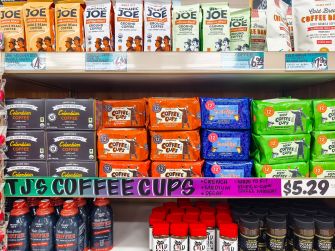
Trader Joe’s is facing a proposed class-action lawsuit alleging the grocery chain misled customers about the caffeine content of one of its store-brand coffee products.
The lawsuit was filed on behalf of four shoppers in California, Illinois, and New York, and centers on the company’s French Roast Low Acid whole-bean coffee.
Plaintiffs argue that the product name “whole bean coffee” led them to believe it contained fully caffeinated beans and describe the labeling as “false and deceptive advertising.” They add that the packaging does not disclose any reduction in caffeine content, and that Trader Joe’s failed to inform buyers that the coffee contained significantly less caffeine than a standard cup.
Based on industry norms, coffee producers typically report caffeine levels only when a specific process is used to reduce them. Fully caffeinated coffee generally appears without a designation, while “decaf” or “half-caff” carry labels indicating their reduced strength and lower caffeine content.
According to testing cited in the filing, the Trader Joe’s product contained roughly half the caffeine of a typical coffee blend, a difference that was not disclosed on the packaging. Without a label such as “half-caff,” the plaintiffs argue, consumers were left to assume they were purchasing a fully caffeinated product.
They further claim they relied on that assumption when buying the coffee and paid a higher price than they would have for lower-caffeine alternatives. The filing states that caffeine content can influence purchasing decisions, particularly for consumers who rely on coffee for its stimulant effect.
“It is so common that it is now cliché that coffee drinkers depend on the caffeine contained therein to provide them with the energy they need to get through the day,” the lawsuit states, adding that the amount of caffeine directly affects consumer purchasing decisions.
Consumer protection laws generally prohibit companies from using labels or marketing that could mislead a reasonable buyer, including by leaving out information that would affect how a product is understood at the time of purchase. The lawsuit argues that failing to disclose reduced caffeine content may have led consumers to misunderstand what they were buying.
Trader Joe’s, a national grocery chain known for its private-label products, markets many items under simplified naming conventions that do not always include detailed product qualifiers, a practice now at issue in the lawsuit.
In addition to economic damages, the lawsuit seeks an order barring the company from continuing to market the product without clearer disclosure.