President Donald Trump said Friday that CNN, MS NOW and Politico are banned from the White House “effective immediately” over coverage he called false, escalating his fight with major news organizations and raising a new question over how far a president can go in restricting White House press access.
Trump announced the move on Truth Social, calling the three organizations “Fake News” and accusing them of repeatedly reporting “FICTION and LIES” about him, his administration and the United States. MS NOW is the cable network formerly known as MSNBC.
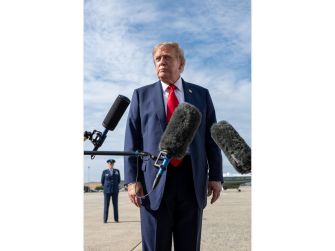
Trump expanded on the announcement hours later, telling reporters that he did not want the outlets “in my office” and that the ban would go “as far as you can.” He also warned that more news organizations could be added.
The White House had yet to spell out how broadly the order would be enforced Friday. CNN personnel remained at their workspace near the briefing room after Trump’s announcement, while a network team continued traveling as part of the television pool assigned to Vice President JD Vance.
The reach of the ban could shape any court challenge. Federal law gives journalists stronger protections for general White House credentials than for access to smaller presidential spaces where the administration chooses which reporters are admitted.
That distinction is already at the center of a court fight involving The Associated Press.
The White House restricted AP access to the Oval Office, Air Force One and other presidential events in 2025 after the organization continued using Gulf of Mexico in its coverage alongside Trump’s preferred name, Gulf of America.
U.S. District Judge Trevor McFadden found that the AP was likely to succeed on its First Amendment claims and ordered White House officials to stop excluding the organization from covered events based on its editorial viewpoint.
A divided D.C. Circuit panel later put much of that order on hold while the administration appealed. The court allowed the White House to control access to limited presidential spaces including the Oval Office and Air Force One, while broader events such as those held in the East Room remained subject to greater protections.
The decision left intact a legal divide that could become important for CNN, MS NOW and Politico. A decision to remove general White House credentials would implicate decades of press-access precedent, while limits focused on restricted presidential events would more closely resemble the issues being litigated in the AP case.
The broader credential rules date back to the 1977 D.C. Circuit decision in Sherrill v. Knight. The court held that bona fide Washington journalists have a First Amendment interest in White House press passes once the government opens those facilities to the press and must receive procedural protections when access is denied.
CNN has faced a White House credential fight with Trump before. During his first term, the administration revoked correspondent Jim Acosta’s press pass following a contentious 2018 news conference. CNN sued, and a federal judge ordered the credential temporarily restored on due process grounds. The White House later reinstated it permanently.
The Reporters Committee for Freedom of the Press condemned Trump’s announcement Friday, with President Bruce Brown saying a ban targeting the three organizations would violate the Constitution.
The White House had not detailed how the ban would be enforced by Friday afternoon. Any challenge will depend heavily on which access the administration ultimately removes, including whether reporters lose general White House credentials or face narrower limits on presidential events.