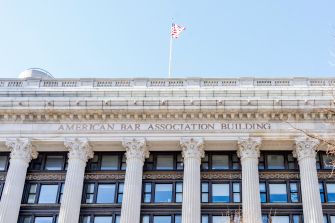
The American Bar Association’s law school accrediting arm has scrapped its diversity and inclusion requirement as the Trump administration weighs whether to end its federal recognition as the nation’s law school accreditor.
The Council of the ABA Section of Legal Education and Admissions to the Bar voted 10 to 6 on Tuesday, September 8, to repeal Standard 206. One member abstained. The repeal took effect immediately and affects the accreditation standards governing 198 law schools and programs that confer J.D. degrees.
Standard 206 required law schools to demonstrate through concrete action a commitment to diversity and inclusion among students, faculty and staff. Its repeal removes that requirement from the ABA accreditation process. Schools remain free to maintain lawful diversity programs.
The vote comes as the ABA council faces a separate threat to its longtime role in American legal education. U.S. Department of Education staff recommended in August that the council lose its federal recognition as a law school accreditor.
Council Chair Melissa Hart said eliminating Standard 206 was a practical step aimed at preserving a national accreditation system and maintaining recognition from the federal government and state courts.
The Education Department’s concerns extend beyond the DEI rule. Staff concluded that the accreditation council was not sufficiently separate and independent from the larger American Bar Association and faulted it for taking too long to address Standard 206.
A federal advisory committee is scheduled to consider the recommendation on September 23. The Education Department will make a final decision later.
The outcome could reshape a system that has governed American legal education for decades.
The ABA council has held federal recognition for law school accreditation since 1952. Its approval also plays a central role in state bar admission rules, with many states relying on ABA accreditation when determining whether a law school graduate is eligible to sit for the bar exam.
Federal recognition and permission to practice law are separate questions, however. State supreme courts generally control admission to the legal profession and set the educational requirements for bar applicants.
A decision by the Education Department to end federal recognition would leave those courts responsible for deciding how much weight to continue giving ABA approval. It could also accelerate efforts already underway in several states to open law school accreditation to other organizations.
Texas, Florida and Alabama have taken steps to reduce their reliance on the ABA or consider alternatives. In January, the Florida Supreme Court ended the ABA’s position as the sole accrediting organization whose approved law schools can qualify graduates to take the state bar exam.
Pressure on Standard 206 had been building for more than a year.
The ABA suspended enforcement of the rule in February 2025 amid changes in federal policy and growing legal challenges to diversity programs. The suspension was later extended through August 2026 while the council considered revisions and ultimately moved toward repeal.
The debate also followed the U.S. Supreme Court’s 2023 decision restricting the consideration of race in college admissions, which prompted universities, employers and other institutions to reassess diversity programs across the country.
The decision to eliminate Standard 206 drew disagreement within the ABA itself. The organization’s House of Delegates declined in August to endorse the repeal, although the accreditation council retained final authority over its standards.
The broader ABA has continued to support diversity in the legal profession. The accreditation council, which exercises separate authority over law school standards, has framed the repeal as a response to the changing legal and regulatory environment rather than a reversal of the association’s broader policies.
Tuesday’s vote settles the future of Standard 206, but the larger fight over the ABA’s place in legal education remains unresolved. The next major decision comes September 23, when the federal advisory committee considers whether the council should keep the recognition it has held for more than seven decades.