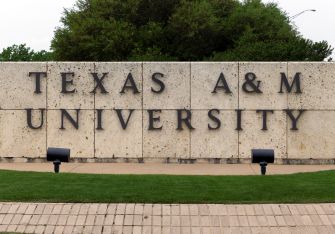
Four professors and the American Association of University Professors have sued the Texas A&M University System, claiming its restrictions on classroom discussions of race, gender and sexuality violate the First Amendment and allow administrators to limit course material based on viewpoint.
The lawsuit, filed Monday in federal court in Houston, asks a judge to block the policy, restore canceled courses and withdraw instructions requiring faculty members to remove readings, films and other material. The challengers include Texas A&M professors Leonard Bright, Vanita Reddy and Landon Sadler, Tarleton State University professor Aaron George and the national faculty organization.
Under the policy, no course within the system may advocate what the university defines as race or gender ideology or topics related to sexual orientation or gender identity. Certain non-core and graduate courses may address those subjects only after the campus president grants written approval based on a necessary educational purpose.
Texas A&M officials have described the policy as an academic oversight measure intended to distinguish education from advocacy and ensure that professors teach the material identified in their approved courses. The system has also said faculty members may discuss relevant subjects as long as the material complies with the policy and course requirements.
The professors claim the rules do not explain what counts as advocacy or what faculty members must establish to show an educational need. Their complaint alleges that administrators have applied the policy beyond direct promotion of a particular position by limiting discussion of the listed subjects and requiring changes to course materials.
Bright’s graduate seminar on ethics in public policy was canceled in January, three days after the spring semester began. According to the complaint, administrators asked him to identify each class meeting during which sexual orientation might arise, but Bright could not predict every subject that could emerge during an open discussion. He told the university that he did not advocate a particular position.
Other faculty members were instructed to remove specific material. Sadler was allegedly told to take the film “Moonlight” and the poem “Trans-Generation” out of one course, while administrators allowed him to show “Barbie.” Reddy and Sadler also had an LGBTQ literature course scheduled for the fall canceled under the policy.
At Tarleton State, the lawsuit states that George was instructed to remove “The Gay Manifesto” and historian Kevin Kruse’s book “White Flight” from a history course. A reading by conservative activist Phyllis Schlafly opposing equal rights for women was not flagged, according to the complaint. The professors argue that the different treatment shows the policy favors some views while restricting others.
Viewpoint discrimination is a First Amendment principle that generally prevents the government from allowing speech on a subject only when it supports an approved position. Public universities have authority to set course requirements and make academic decisions, but the professors argue that Texas A&M crossed that line by restricting some views on race, gender, and sexuality while allowing others.
The lawsuit also argues that the policy is unconstitutionally vague because it does not define advocacy or explain how professors must establish a necessary educational purpose. A government rule may violate due process when people cannot reasonably determine what it prohibits or when unclear language gives officials too much freedom to enforce it selectively.
The professors claim the uncertainty has caused faculty members to remove material and avoid classroom discussions because they fear discipline. Courts often refer to that deterrent effect as a chilling effect on speech. The complaint states that violations of the policy may result in disciplinary action, including termination.
The restrictions followed months of controversy at Texas A&M after a student recorded a confrontation with a professor over a lesson involving gender identity. After state Rep. Brian Harrison posted the video on social media, criticism from state leaders intensified.
The professor was fired after the video circulated widely. Then President Mark A. Welsh III, who had initially defended her, resigned days later amid criticism from Gov. Greg Abbott and Lt. Gov. Dan Patrick. Chancellor Glenn Hegar later ordered a systemwide review of courses.
The Board of Regents adopted the policy in November 2025 and revised it the following month. Regent Sam Torn said at the time that university presidents would be responsible for distinguishing academic instruction from advocacy.
Texas A&M has said six of more than 5,400 courses reviewed for the spring were canceled. The professors argue that the number does not account for courses that were changed, materials that were removed, or discussions that faculty members avoided because of the policy.
The challenge is the second recent lawsuit involving restrictions on course content at a Texas public university system. The American Association of University Professors and one of its Texas chapters have also sued the Texas Tech University System over separate academic policies.
The complaint seeks preliminary and permanent court orders blocking enforcement of the policy, restoring canceled courses and reversing instructions that required professors to remove course material.