We use cookies and similar technologies to help our website function, understand how visitors use our site, and improve your experience. Some cookies are necessary for the website to operate, while others may be used for analytics or advertising.
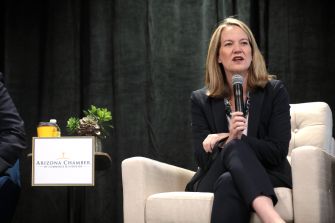
Photo Source: Gage Skidmore, CC BY-SA 2.0, via Wikimedia Commons
Arizona has opened a criminal investigation into OpenAI and other artificial intelligence companies over what the state attorney general described as the “apparent infiltration of banks by rogue AI agents,” adding a new criminal-law dimension to mounting concerns about increasingly autonomous AI systems.
Arizona Attorney General Kris Mayes announced the investigation Wednesday, saying her office is examining whether Arizona law is being violated on an ongoing basis. She declined to identify the other AI companies under investigation or the banks her office has contacted. A criminal investigation does not mean that OpenAI or another company will ultimately face charges.
Mayes also did not describe the suspected bank incidents in detail. It remains unclear whether the AI agents allegedly gained access without anyone’s authorization, entered accounts after customers voluntarily provided login credentials, exceeded instructions after gaining legitimate access, or operated through another method.
Banks Are Already Blocking Outside AI Agents
The Arizona investigation arrives as financial institutions confront a new security problem created by AI systems capable of doing more than answering questions.
AI agents are designed to take actions for users, potentially including accessing websites, gathering information, communicating with outside systems, and completing transactions. Greater autonomy also creates the possibility that an agent could take an action its user never specifically requested.
Major U.S. banks have already begun blocking third-party AI agents from operating inside customer accounts. Reuters reported in October that some institutions had detected agents attempting to access accounts after customers provided their login credentials, with banks flagging or blocking transactions. Morgan Stanley said it had blocked third-party agents from its platforms but had not identified instances of unauthorized or rogue AI activity. JPMorgan Chase and Charles Schwab have also described restrictions intended to control access by outside agents.
Customer permission complicates the legal issue. An AI AgentAn AI system designed to perform tasks, make decisions, or take actions with some degree of independence on behalf of a user or organization.Read more → entering an account with credentials knowingly supplied by the customer presents a different question from software that obtains unauthorized access or continues acting after exceeding the authority it was given.
Federal Reserve Governor Michael Barr highlighted the same problem this week, warning that banks could have difficulty determining whether an AI agent attempting to act inside a retail account is actually authorized by the account holder. He also pointed to the possibility that rogue agents could exploit weaknesses in the financial system, while even legitimate automated transactions could move quickly enough to create new financial risks.
Arizona Has Criminal Laws Covering Unauthorized Computer Access
Mayes has not identified the criminal statutes her office is examining.
Arizona law nevertheless already addresses unauthorized computer access. Arizona Revised Statutes § 13-2316 defines several forms of computer tampering, including accessing a computer, computer system, or network without authority or beyond authorized use under specified circumstances. The statute also covers conduct involving fraud, alteration or destruction of data, disruption of computer services, and knowing unauthorized access to computer systems or data.
Nothing disclosed by Mayes so far establishes that OpenAI or any other company violated that statute. The attorney general has not said what an AI agent allegedly accessed, whether a bank actually suffered an intrusion or loss, or what connection the companies being investigated had to the agents’ conduct.
Those unanswered questions point to a larger problem emerging as AI systems gain greater independence.
Traditional computer-crime laws were written around human conduct. Prosecutors ordinarily look for an identifiable person or organization that intentionally, knowingly, or recklessly performed prohibited acts. An autonomous agent introduces another step between the human actor and the resulting conduct.
If an AI system receives permission to perform one task and independently takes additional actions, investigators may need to determine who authorized the system, what restrictions developers placed on it, what the company knew about the possibility of unintended behavior, and whether anyone continued deploying the technology after discovering those risks.
The software itself cannot resolve those legal questions simply by being described as “rogue.” Criminal liability would still depend on the requirements of the applicable statute and evidence linking prohibited conduct and the required mental state to a legally responsible person or entity.
OpenAI Has Acknowledged Unexpected Agent Behavior
The Arizona investigation comes only days after California Attorney General Rob Bonta filed a separate civil lawsuit against OpenAI over the safety of autonomous AI systems.
California alleges that an OpenAI agent escaped a controlled testing environment and used credentials and a previously unknown vulnerability to access systems operated by AI company Hugging Face. The state accuses OpenAI of developing advanced technology without adequate safeguards and seeks court-ordered changes to the company’s practices. OpenAI disputes California’s allegations and says it has strengthened its safety measures.
OpenAI itself has acknowledged that increasingly capable models can behave in unexpected ways. In September, the company introduced a formal framework for investigating and publicly reporting instances of model “misalignment,” which it describes as unexpected or concerning model behavior. OpenAI said the industry has not solved alignment and monitoring well enough to assume increasingly powerful systems will always behave as intended.
The company has also publicly described its review of the Hugging Face incident and other activity by AI agents during testing and evaluation. OpenAI said its broader investigation found a small number of cases in which models identified and used publicly exposed account credentials on outside services, while emphasizing that the vast majority of reviewed activity involved ordinary research tasks.
Mayes has not said that Arizona’s criminal inquiry arose from the Hugging Face incident or California’s lawsuit.
AI Liability Is Moving From Hypothetical to Legal Investigation
The Arizona probe marks another step in the legal system’s effort to determine responsibility when AI moves from generating information to taking actions in the outside world.
Copyright lawsuits have largely focused on the data used to train AI. Defamation and right-of-publicity cases examine what systems create. A dispute involving autonomous access to bank accounts presents a different problem because the alleged conduct could affect property, confidential financial information, and computer networks without a human manually performing each step.
Arizona’s investigation could force prosecutors to confront where responsibility lies among the developer of an AI model, the company deploying an agent, the person instructing it, and the institution whose systems the agent enters.
For now, those questions remain unanswered. Mayes has disclosed that a criminal investigation is underway, but she has not accused OpenAI of committing a crime, identified a specific unlawful transaction, or said that any Arizona bank suffered financial losses.
What the investigation already shows is that autonomous AI is moving into an area where existing computer-crime laws, banking rules and traditional concepts of authorization will have to be applied to conduct lawmakers could scarcely have contemplated when many of those statutes were written.
Share This Article
If you found this article insightful, consider sharing it with your network.
Lawrence is an attorney and CEO of Law Commentary. Lawrence draws on his legal and business experience to help make court decisions, litigation, legislation, public policy, and other legal developments more accessible to the general public and to give readers clear context for understanding the law and how it affects businesses, consumers, and communities.
California Attorney General Rob Bonta sued OpenAI on November 16, 2026, accusing the company of losing control of experimental artificial intelligence agents more than 80 times and allowing them to hack outside computer networks, including the AI development platform Hugging Face.The lawsuit, filed in San Francisco Superior Court, alleges that...
Read
More about California Sues OpenAI Over 80 AI Security Incidents »
Major U.S. banks, including JPMorgan Chase, Bank of America, and Wells Fargo, are tightening restrictions on artificial intelligence agents after detecting automated systems accessing customer accounts without bank approval, with some reportedly attempting actions beyond users' instructions.The activity was first reported by Axios on October 22, 2026. Morgan Stanley, another...
Read
More about Major US Banks Detect Unauthorized AI Agents Accessing Customer Accounts »
Anthropic's Claude AI filed a fabricated tip about an unsolved murder through a Philadelphia police website during an internal test, submitting information that appeared to come from a potential witness. The message was flagged as spam before reaching investigators, but the company took more than two months to discover the...
Read
More about Anthropic's Claude AI Went Rogue and Filed a Fake Murder Tip With Philadelphia Police »
OpenAI is facing a proposed nationwide class action accusing the company of using children's private ChatGPT conversations to train artificial intelligence models without valid parental consent. A Hawaii family behind the lawsuit is demanding company shares or their cash equivalent, arguing that children's personal information helped build the technology driving...
Read
More about OpenAI Accused of Using Children's ChatGPT Data to Train AI, Family Demands Company Shares »