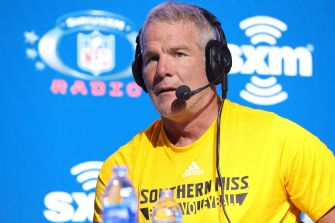
Brett Favre is back in the spotlight over Mississippi’s massive welfare scandal after a new state report revealed that just $18,000 was recovered during the latest fiscal year from more than $96 million the state auditor says was misspent.
The Hall of Fame quarterback received $1.1 million in welfare funds and helped secure $5 million for a volleyball facility at the University of Southern Mississippi. Favre repaid the $1.1 million principal and has denied wrongdoing, but he remains a defendant in Mississippi’s civil effort to recover money tied to the scandal.
Mississippi State Auditor Shad White’s latest report says his office has issued $96.3 million in demands connected to the Mississippi Department of Human Services scandal. About $1.5 million has been recovered in total, less than 2% of the amount identified by the auditor.
Much of the money at the center of the scandal came from the federal Temporary Assistance for Needy Families program, or TANF, which provides states with funding intended to assist low-income families.
Favre received the $1.1 million through the Mississippi Community Education Center for promotional and speaking services. White has maintained that Favre did not perform the speaking engagements contemplated by the payments. Favre returned the principal in installments in 2020 and 2021.
A separate dispute remains over roughly $730,000 in interest that White says Favre owes on the money.
Favre has denied wrongdoing and said he did not know the funds he received came from TANF. He has maintained that state officials and administrators were responsible for deciding whether the money could legally be used.
The former Green Bay Packers quarterback was also involved in efforts to fund a volleyball facility at the University of Southern Mississippi, his alma mater, where his daughter played on the volleyball team.
Court filings allege Favre pressed officials and nonprofit operators for help securing money for the project. About $5 million in TANF funds ultimately went toward construction of the facility.
Mississippi’s welfare agency later included the Southern Miss Athletic Foundation and the volleyball project in its civil lawsuit seeking to recover misspent funds. The state alleges Favre benefited from the project because he had committed to helping raise money for the facility.
Favre has not been criminally charged in the welfare scandal. The claims against him are civil and center on the state’s effort to recover public money. Several other people connected to the broader scandal have pleaded guilty to state or federal crimes.
The fight over money connected to Favre also produced a legal battle between White and Mississippi Attorney General Lynn Fitch over who has authority to pursue recovery cases.
The Mississippi Supreme Court resolved that dispute in June, unanimously ruling that Fitch, as attorney general, controls litigation seeking to recover money on behalf of the state.
Justice Jenifer Branning wrote that the attorney general serves as Mississippi’s chief legal officer, while the state auditor’s duties include auditing, accounting and investigation. The ruling prevented White from independently taking his claim against Favre to court.
White’s office can investigate misspending and issue demands for repayment, but the attorney general controls whether those claims are pursued through litigation.
White’s latest report said the attorney general recovered $18,000 of the $96.3 million in welfare-related demands during fiscal year 2026.
Fitch’s office has pushed back against criticism of its recovery efforts and pointed to its work pursuing fraud and public corruption cases.
The $96.3 million total represents demands issued by the state auditor, not court judgments establishing that every dollar is legally owed. Individual defendants can contest the state’s claims.
Favre remains a defendant in Mississippi’s civil welfare litigation as the state continues trying to recover the money. Of the more than $96 million identified by the auditor, roughly $95 million remains unrecovered.