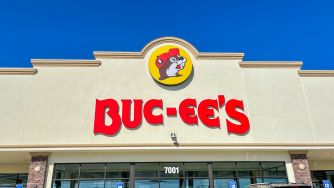
Buc-ee’s has sued the company behind Beaver’s Mini Mart in Beavercreek, Ohio, claiming the neighborhood store’s name, cartoon beaver, and red signs are likely to be mistaken for the travel center chain’s protected branding.
Buc-ee’s filed the complaint July 28 in the U.S. District Court for the Southern District of Ohio against Hanes Road Carryout Inc., which operates Beaver’s Mini Mart. The Texas-based chain accuses the company of trademark infringement and unfair competition under federal law.
According to the complaint, the Ohio store uses a smiling cartoon beaver with wide eyes alongside the word “Beaver’s” in red lettering. Buc-ee’s claims the combination is close enough to its own branding that customers may believe the businesses share an owner, have a licensing agreement or are otherwise connected.
The dispute comes months after Buc-ee’s opened its first Ohio travel center in Huber Heights, about 16 miles from Beaver’s Mini Mart. Buc-ee’s states that it has used its beaver mascot for decades and owns federal trademark registrations covering its name, logo and convenience store services.
Beaver’s Mini Mart owner Vik Boparai has rejected the company’s claims. His family says it has operated the store since 2017, years before Buc-ee’s entered the Ohio market. In a letter posted at the business, Boparai said the store’s name and logo represent its connection to Beavercreek and that he intends to fight the lawsuit.
Trademark infringement under the Lanham Act centers on whether consumers are likely to be confused about the source, ownership or sponsorship of a business. Courts compare the marks as a whole and consider how customers encounter them in the marketplace rather than examining one word, color or image by itself.
Buc-ee’s bases its claim on the combined use of a smiling beaver, red lettering and the name “Beaver’s.” The company also points to the fact that both businesses sell convenience store products, placing the disputed branding in the same general retail market.
Courts evaluating consumer confusion also consider the overall commercial setting. Beaver’s Mini Mart operates as a neighborhood corner store tied to the Beavercreek name, while Buc-ee’s runs large travel centers known for fuel, food and branded merchandise. The dispute will require the court to decide whether the similarities in the names and logos outweigh the differences in how the businesses present themselves to customers.
Federal trademark rights protect a specific mark that identifies the source of goods or services. Courts assess the full commercial impression created by a mark, including its wording, design and use in the marketplace, when deciding whether consumers are likely to confuse one business with another.
Buc-ee’s relies on the combined effect of the mini mart’s mascot, name and retail setting rather than the use of a beaver alone. The complaint claims those elements create the impression that Beaver’s Mini Mart is connected to Buc-ee’s even though the businesses have no affiliation.
The mini mart’s history does not automatically defeat Buc-ee’s claims. Trademark priority generally depends on when a mark was first used or registered, not when the owner opened a location in a particular state. Buc-ee’s alleges that its rights were established long before Beaver’s Mini Mart began operating in 2017.
The store’s local history remains part of its response to the lawsuit. Boparai maintains that the name comes from Beavercreek and identifies an independent neighborhood business rather than an attempt to associate the store with Buc-ee’s.
Buc-ee’s also accuses Hanes Road Carryout of unfair competition. Federal law prohibits commercial branding that falsely suggests a business is sponsored, approved or affiliated with another company. Buc-ee’s relies on the same alleged similarities in the name, mascot and signs to support that claim.
The chain argues that the mini mart’s branding allows it to benefit from the reputation Buc-ee’s has developed through advertising, sales and national recognition. Beaver’s Mini Mart disputes that account and has described its identity as local rather than an imitation of the larger company.
The lawsuit has drawn support for the mini mart from more than 20 businesses in Beavercreek and nearby communities. Restaurants, shops and service providers have temporarily added beavers to their social media logos in response to the case.
A nearby bakery is also selling beaver-themed shirts and cookies and has pledged half of the shirt profits to help cover the store owner’s legal costs. A separate online fundraiser on GoFundMe collected more than $5,000 toward a $7,000 goal within two days.
The Ohio case has also renewed attention on Buc-ee’s history of enforcing its trademarks against businesses that use cartoon animal mascots. During the July 26 episode of “Last Week Tonight,” host John Oliver criticized the convenience store chain’s efforts and displayed merchandise featuring a squirrel logo designed to resemble Buc-ee’s mark.
Buc-ee’s is asking the court to permanently stop Hanes Road Carryout from using the Beaver’s Mini Mart name and logo or other branding found to infringe its trademarks. The chain also seeks the destruction of signs and promotional materials, profits tied to the alleged infringement, damages, legal fees, and court costs.