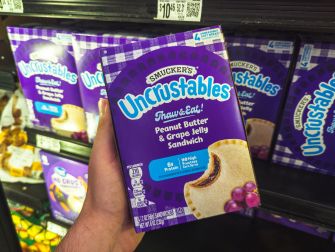
A federal judge has rejected Trader Joe’s bid to dismiss a trademark claim in J.M. Smucker’s lawsuit accusing the grocer of copying the distinctive look of its Uncrustables sandwiches.
The dispute pits Smucker’s familiar round, crimped sandwich design against a Trader Joe’s product the retailer describes as a “squircle,” or a square with rounded corners. At issue is whether the Uncrustables design has become famous enough to receive heightened protection under federal trademark law.
U.S. District Judge John R. Adams ruled Aug. 28 that Smucker had alleged enough facts to continue pursuing its federal trademark dilution claim. He also rejected Trader Joe’s request to move the lawsuit from Ohio to California.
Smucker sued Trader Joe’s in October 2025, accusing the retailer of copying visual features associated with Uncrustables, including the round crustless shape, crimped edge, and images showing the sandwich and its filling. The company also challenges elements of Trader Joe’s packaging and alleges trademark infringement, unfair competition, and related violations.
Trader Joe’s sought to dismiss the dilution claim by arguing that the sandwich designs lack the widespread recognition required for that level of trademark protection. In court filings, the retailer pointed to marks such as Nike’s swoosh and McDonald’s golden arches as examples of the degree of fame contemplated by federal law.
Smucker says it has invested more than $1 billion over at least two decades developing goodwill associated with Uncrustables and the trademark rights tied to its sandwich designs. The company also says it produces about 1.5 billion Uncrustables each year and sells the products in thousands of stores nationwide.
The Lanham Act, the federal law governing trademarks, reserves dilution protection for marks widely recognized by the general U.S. consuming public. Courts can consider advertising, sales, geographic reach, public recognition, and federal registration when deciding whether a mark meets that standard.
Ordinary trademark infringement focuses largely on whether consumers are likely to be confused about who made, sponsored, or approved a product. Dilution protects certain famous marks from uses that weaken their ability to identify a single source, even when the competing products do not create the same type of consumer confusion.
Adams found Smucker’s allegations about advertising, sales, registration, and consumer recognition sufficiently tied to the disputed Uncrustables design marks to allow the claim to move into discovery. That process will give both companies an opportunity to develop evidence about how consumers recognize the designs and whether they meet the federal fame standard.
The crimped edge raises a separate limit on trademark protection. Product designs can function as trademarks when consumers associate their appearance with a particular source, but useful product features generally remain available to competitors.
Trader Joe’s argues that the crimping around its sandwiches seals the edges and keeps the filling inside. Smucker claims the round shape, crimping, and other visual elements together have become distinctive identifiers associated with Uncrustables.
How those features are characterized could affect Smucker’s broader infringement claims. Trademark protection can cover distinctive product designs that identify their source, while features whose value comes from the job they perform may be considered functional and treated differently under federal law.
Trader Joe’s also asked Adams to transfer the case to California, where the retailer is headquartered, and its third-party sandwich producer is located. The judge found the competing venue considerations roughly balanced and gave substantial weight to Smucker’s decision to sue in Ohio, where the company is headquartered and alleges the challenged products were sold.
Smucker is seeking monetary relief and court orders barring conduct found to infringe its trademark rights. The case remains pending in the U.S. District Court for the Northern District of Ohio, where Adams said a case management conference will be scheduled separately.