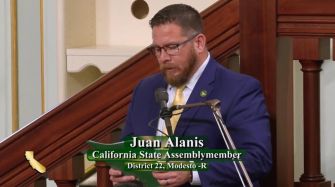
In a bipartisan effort, Republican Assembly member Juan Alanis and Democrat Rebecca Bauer-Kahan have successfully persuaded their colleagues in the California Assembly to advance legislation mandating age verification on pornography websites. The bill, Assembly Bill 3080, aims to protect children from exposure to explicit and violent sexual material online.
Juan Alanis, a former Stanislaus County sheriff’s sergeant and crimes-against-children detective, emphasized that the bill is not an attack on the adult entertainment industry but a measure to safeguard minors. "This bill is simply about protecting children – and the harmful exposure to increasingly available and increasingly violent sexual material online,” Alanis stated.
Bauer-Kahan, a prominent women’s rights advocate, highlighted alarming statistics to underscore the bill's importance. She pointed out research indicating that 40% of college-aged women have reported being choked during sexual encounters, a behavior often learned from watching porn. “It is about the safety of our children. It is about making sure that they learn healthy behaviors,” Bauer-Kahan told the Assembly.
Their arguments struck a chord with the Assembly members, as none of the 80 members voted against the bill, though 15 abstained from voting.
Under AB 3080, pornography sites would be required to take "reasonable steps" to verify that users are adults. This could involve using age verification software or asking users to provide a credit card or government-issued ID. Importantly, the bill stipulates that any data collected must ensure user anonymity and not create a record of the user’s online activity.
The bill now proceeds to the Senate, where it will face testimony from various groups, including parents' rights and church organizations, free speech advocates, and porn producers.
Joseph Kohm, director of public policy at the Colorado-based Family Policy Alliance, testified last month that children frequently visit online porn sites featuring sexual violence and verbal degradation. “They are learning about sexuality from a perspective that portrays sex as physical abuse,” Kohm told the Assembly Judiciary Committee.
Free speech advocates argue that AB 3080 would infringe on the First Amendment rights of adults to access online porn. Industry representatives also warned that the age-verification requirement could significantly reduce traffic to their sites, as seen in other states with similar laws. Jiz Lee, a queer porn performer, described the measure as a "customer deterrent," adding that it would negatively impact business in California, where many subscribers are based.
Alison Boden, executive director of the Free Speech Coalition, noted that less than 1% of users complete the age-verification process in states where it is required. “What they do, according to our data, is hit the back button and find a site that doesn’t comply with the law,” Boden explained.
California joins a small group of states that have adopted age-verification requirements for porn sites, including Arkansas, Mississippi, Montana, North Carolina, Texas, Utah, Virginia, and Kentucky. These states followed model legislation from the conservative Center for Renewing America. Notably, Pornhub blocked users in these states following the implementation of the new laws.
Internationally, the European Union passed its own age-verification law in December. Bauer-Kahan pointed to Europe as a model, noting that European countries have stronger privacy laws and have managed to implement age verification without compromising user privacy.
Alanis argued that the bill aligns with existing California laws that restrict children's access to adult-only products like tobacco and firearms. “California requires its own tailored approach,” he said. “We have worked to craft a workable bill using an existing statute that California has long used to protect our children from other types of harm.”