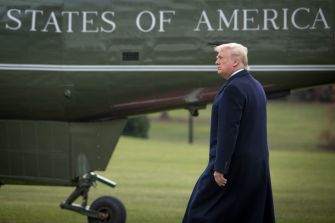
Photo Source: President Donald J. Trump (Shutterstock Image)
On December 1, 2020, Judge Beryl Howell of the United States District Court for the District of Columbia ordered the partial unsealing of a memorandum opinion and order dated August 28 of this year. The result, redacted to omit the names of all parties concerned and all of the case’s background, revealed that an investigation has been taking place into:
(1) “a secret lobbying scheme in which and ’”;
and
(2) a related bribery conspiracy scheme in which would offer a substantial political contribution in exchange for a presidential pardon or reprieve of sentence using ‘as the intermediaries to deliver the proposed bribe’.”
News outlets pounced upon the story, and rushed to the conclusion that the President was involved in a bribery-for-pardon scheme. For his part, the President responded with a brief Tweet: “Pardon investigation is fake news.”
Fake or true, there does appear to be an ongoing investigation, but one has to point out that the lobbying scheme apparently involves only nameless (but not redacted) “senior White House officials” and not the President himself. Still, the allegations seemed juicy enough to be taken up by the media. The only problem is that the memorandum was so extensively redacted that there isn’t much more of a story than that, and probably won’t be one for a while, as the investigation is, we may assume, continuing.
In reality, the memorandum isn’t even about the investigation per se. What emerges through the redactions is a discussion on Attorney-client privilegeAttorney-client privilege protects confidential communications between a lawyer and a client when they are made for the purpose of seeking or providing legal advice. and whether the information on electronic devices seized at an undisclosed office location can be used as evidence in the case.
Quite a bit of equipment – “including iPhones, iPads, laptops, thumb drives and computer and external hard drives” – was seized, containing “several terabytes of data.” The question addressed in the memorandum is whether the data can be used in the investigation, or whether it is protected by attorney-client privilege because one of the characters who emerged from the redacted drama appears to be the attorney of the person being investigated. (On the other hand, the redaction of the entire background section of the memorandum makes it impossible to determine whether the premises where the electronic equipment was seized were indeed the office of an attorney.)
Judge Howell granted the government’s motion to examine the seized data as possible evidence, based on a finding that, notwithstanding any attorney-client relationship or , any communication related to the alleged LDA or Bribery-for-pardon schemes, between or among those individuals, in which communications was a participant or otherwise a recipient, is not protected by the attorney-client or any other privilege, and is therefore reviewable by the government’s investigative team.
The court’s argument for granting the government permission to investigate the seized materials rests on a character in the drama “who is not an attorney” and to whom “each of the email communications submitted by the government was directed, copied or forwarded.”
The complicating issue is that there appears to have been a relationship between the target of the investigation’s attorney and the non-attorney third party, raising the possibility that the third party might have operated as an agent of the attorney, in which case the third party’s communications could be covered by attorney-client privilege. As far as can be made out, the memorandum exists to consider exactly that topic, ultimately deciding that “the attorney-client privilege does not protect communications to third parties, and here was such a third party to each of the emails submitted to the government.”
Although the memorandum clearly isn’t fake, its contents aren’t as sensational as other outlets have sought to make them appear. Short of a ten-second flash and an interesting lesson on attorney-client privilege, however, the memorandum doesn’t constitute much in the way of news at all.
Share This Article
If you found this article insightful, consider sharing it with your network.
Lindsay Clancy’s defense lawyer asked President Donald Trump to pardon her after her Massachusetts murder trial ended in a mistrial, even though presidential pardon power does not extend to the state murder charges against her.Attorney Kevin Reddington made the appeal Tuesday on ABC’s “Good Morning America,” asking Trump to consider...
Read
More »
The sweeping investigation into former President Donald Trump escalated dramatically yesterday for attorney Rudy Giuliani, as the former Trump ally and lawyer's home and office were raided. The Justice Department executed the search warrants as part of an active investigation into Giuliani's dealings with numerous foreign Ukraine men during Trump's...
Read
More »
While the government is actively conducting a criminal investigation and pursuing fugitives, the media has neither a First Amendment right, nor a traditional public access right, to obtain sealed records. In a case clarifying the vital issues involved in the All Writs Act (AWA), which gives federal courts the power...
Read
More »
In the law, timing is everything. With the 2024 presidential election looming, a judge was asked to consider the government’s proposed December 11 court date for Trump’s classified documents trial. After considering arguments from both parties in the face, federal district Judge Aileen Cannon set the start date for the...
Read
More »
Americans are fascinated by the lives of the rich and famous. But few people actually know what they are really like. And those “lucky ones” usually have to sign non-disclosure agreements (NDA) that carry heavy consequences for telling all. Melania Trump’s ex-aide is one of them. She wrote a book...
Read
More »