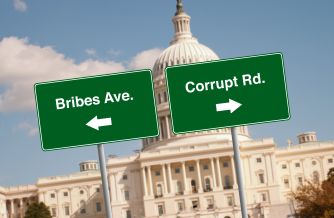
A campaign contribution can violate federal election law without being a bribe. To cross into federal bribery, prosecutors generally need evidence of something more: a corrupt exchange in which money or another thing of value is given or accepted in return for official government action.
That distinction has taken on new significance following a ProPublica investigation into Republican Sen. Susan Collins of Maine and former defense contractor executive Martin Kao. ProPublica reported on September 22 that FBI agents sought in 2024 to open a broader public-corruption investigation into interactions between Collins, her political network and Kao, who had already pleaded guilty to illegally funneling money into federal elections.
No bribery charge has been filed against Collins, and her office denies Kao’s allegations of pay-to-play dealings. The FBI has also said an earlier investigation found nothing implicating Collins or her campaign. ProPublica maintains that the FBI statement concerned an earlier inquiry and did not address the separate investigation agents sought to pursue in 2024.
The unresolved allegations provide a useful illustration of one of the most difficult lines in federal public-corruption law: when does political fundraising become an illegal exchange for government action?
Federal Bribery Requires an Exchange
The federal bribery statute, 18 U.S.C. § 201, makes it a crime to corruptly give, offer, or promise something of value to a public official with the intent to influence an official act. The statute also reaches public officials who corruptly demand, seek, receive, or agree to accept something of value in return for being influenced in the performance of an official act. Members of Congress fall within the statute’s definition of federal public officials.
The critical concept is quid pro quo—literally, something for something.
A donor may contribute to a politician because they support the candidate’s policies. Businesses and individuals may also hope that an elected official will listen to their concerns, support legislation they favor, or adopt policies that benefit them. Political access and political support can raise ethical questions, but those circumstances alone do not establish federal bribery.
The criminal issue arises when the evidence shows an agreement linking the contribution to government action: the money is provided in return for an official decision or commitment.
Timing can be evidence. So can emails, text messages, testimony, internal records, and statements describing what the donor expected to receive. None automatically establishes bribery standing alone. Prosecutors must prove the corrupt exchange required by the applicable federal statute.
The Supreme Court Has Drawn a Narrow Line Around Campaign Contributions
The Supreme Court confronted the relationship between campaign contributions and public corruption in McCormick v. United States.
The 1991 case involved a West Virginia legislator who received cash payments from foreign doctors while supporting legislation that benefited them. The prosecution proceeded under the Hobbs Act, which prohibits extortion affecting interstate commerce.
The Supreme Court ruled that when the payment at issue is a campaign contribution, the government must prove a quid pro quo. A contribution cannot be converted into criminal extortion simply because the donor wanted favorable government action. The Court required an explicit promise or undertaking connecting the payment with official conduct.
A year later, Evans v. United States further defined the exchange requirement. The Court held that the crime can be complete when an official accepts a payment knowing that it is being made in return for official acts. The promised government action does not have to be successfully carried out before criminal liability can arise.
The Supreme Court narrowed federal corruption law again in McDonnell v. United States in 2016. Former Virginia Gov. Bob McDonnell had been convicted after accepting loans and gifts while assisting a businessman seeking state support for a dietary supplement.
The Court held that an “official act” requires a decision or action on a specific and focused government matter involving a formal exercise of governmental power. Merely arranging a meeting, speaking with another official, or hosting an event does not by itself satisfy that definition. An official can still violate the law by agreeing to use governmental power on a qualifying matter, but the government must identify the official action connected to the alleged exchange.
Together, the cases create a demanding standard. Prosecutors need more than evidence that a donor contributed money and later received favorable treatment. They need evidence tying the contribution to an agreement concerning official government action.
Illegal Campaign Contributions Are a Separate Question
The bribery inquiry is different from whether a contribution itself violates federal campaign-finance law.
Federal contractors face particularly strict rules. Under 52 U.S.C. § 30119, federal government contractors generally cannot make political contributions or expenditures while covered by the prohibition. The Federal Election Commission says the restriction can apply while a contractor is performing a federal contract or negotiating for one. It also applies to contributions to super PACs, even though those committees can accept unlimited contributions from many other permissible sources.
Federal law separately prohibits contributions made in another person's name. Under 52 U.S.C. § 30122, someone cannot provide money to another individual or entity and use that person or organization to disguise the identity of the real contributor. Knowingly allowing one's name to be used for such a contribution and knowingly accepting one are also prohibited.
These are often called straw-donor or conduit contribution schemes.
Kao admitted violating campaign-finance laws under those principles. In 2022, the Justice Department announced that he pleaded guilty to conspiring to make unlawful campaign contributions, making illegal contributions, and causing false information to be submitted to the FEC. Prosecutors said Kao and others created a shell company that used government-contractor money to contribute to a PAC supporting a U.S. Senate candidate. They also used family members as conduits for contributions to the same candidate’s campaign and reimbursed those donations with company-related funds.
FEC records identify the candidate as Collins and the PAC as 1820 PAC. The commission found that Navatek, later known as PacMar Technologies, was the true source of a $150,000 contribution made through the Society of Young Women Scientists and Engineers. PacMar eventually entered a conciliation agreement with the FEC and agreed to pay a $325,000 civil penalty over the contractor-funded contribution made in another entity’s name.
Those findings establish campaign-finance violations involving Kao and the company. They do not, by themselves, establish that Collins accepted a bribe.
The Collins Reporting Raises the Separate Quid Pro Quo Question
ProPublica’s new reporting concerns what investigators were examining beyond the already established campaign-finance scheme.
According to ProPublica, Kao told investigators that during a 2019 meeting with Scott Reed, who headed a super PAC supporting Collins, Navatek was asked for a $500,000 contribution. Kao alleged that he wanted additional federal contracts for the company and wanted Collins to know who was providing the money. ProPublica reported that Kao subsequently caused $150,000 to be sent through the shell company to 1820 PAC.
ProPublica also reported that FBI agents reviewed company records, emails, and communications involving Navatek, lobbyists, and people connected to Collins. Among other things, investigators examined donations made around the time Collins supported federal funding for research involving Navatek and the University of Maine. Kao claimed that private conversations connected political support with federal funding, allegations Collins’ office has vigorously denied.
Collins’ deputy chief of staff told ProPublica that the senator’s office rejected Kao’s bribery and pay-to-play allegations, that the campaign was not involved in Kao’s discussions with the super PAC and that Collins and her staff cooperated with federal investigators. The office has maintained that Kao made the illegal contributions without the campaign’s knowledge.
No court has determined that Collins participated in a quid pro quo, and ProPublica itself acknowledged the challenges investigators faced in assessing Kao’s claims. Kao was a convicted defendant cooperating with prosecutors while seeking favorable treatment, making corroboration particularly important.
The FBI nevertheless had documentary evidence that ProPublica says agents believed justified further investigation. According to the publication, agents sought authorization in late 2024 for a broader public-corruption inquiry after reviewing Kao’s allegations and large volumes of seized records. That investigation did not result in charges.
The distinction between the established campaign-finance crimes and the unproven bribery allegations is precisely where federal corruption law draws its line.
An illegal contribution can be prosecuted because of who supplied the money, how it was routed, or whether the real donor was concealed. Bribery requires proof of the bargain behind the money.
For prosecutors, the question is ultimately not simply who gave, who received, or who later benefited. It is whether the evidence proves that something of value was exchanged for an official act.