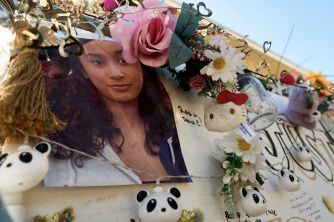
D4vd, the platinum-selling artist charged in the killing of 14-year-old Celeste Rivas Hernandez, sat through another day of testimony Thursday in a Los Angeles courtroom as forensic experts detailed DNA evidence connecting him to a trash bag containing what prosecutors say was the teenager's blood.
The bag was pulled from the garage of the singer's Hollywood Hills rental during a search conducted on September 17, 2025, not long after Rivas's dismembered remains were discovered inside the front trunk of his towed Tesla.
Prosecutors contend that the musician, whose legal name is David Anthony Burke, fatally stabbed Rivas inside the home on April 23, 2025, then dismembered her body in the garage sometime in the following weeks.
Samantha Tosch, a criminalist with the Los Angeles Police Department, told the court that a swab lifted from the trash bag revealed a mixture of genetic material from four separate people, at least two of them male. She testified that Burke's profile was included among that mixture.
A separate wipe recovered from inside the bag, she said, carried DNA that was overwhelmingly more likely to belong to Rivas than to a random unrelated person, though Burke's genetic material did not turn up on that particular item. Her testimony followed an earlier account from another criminalist, who described finding stained wipes tucked inside a smaller bag nested within the larger one, stains that turned bright pink under a chemical field test used to flag the possible presence of blood.
Tosch went on to detail additional stains recovered throughout the garage that matched Rivas's DNA, including samples pulled from a rowing machine, a rubber floor mat, a charging cable for the Tesla, and a tarp. She added that Rivas's genetic material also surfaced in a rear compartment of the vehicle, apart from the front trunk where her remains were ultimately found.
Under questioning from defense attorney Blair Berk, Tosch conceded that DNA can transfer onto surfaces without direct contact and that the software used to analyze the mixture only estimates the probability of Burke's presence rather than confirming it outright. She nonetheless maintained that, in her professional judgment, his DNA was present on the bag.
Prosecutors allege Burke arranged for Rivas to come to his home by Uber on the night of the killing, stabbed her to conceal an ongoing pattern of sexual abuse, then left town on a promotional tour before returning to dispose of her remains.
Burke has pleaded not guilty to murder, continuous sexual abuse of a child, and unlawfully mutilating human remains, and his attorneys argue the evidence won't show he killed her.
Separately, criminalist Lisa LaHendro testified that she used microscopic analysis to match a torn piece of blue plastic recovered from Rivas's body to a hole in an inflatable pool found in the garage, describing how the broken edges lined up like matching puzzle pieces. She was unable to reach the same certainty comparing a scrap of black fabric from the garage to the leggings recovered with Rivas's remains, explaining that water damage and decomposition had degraded the material too much for a reliable comparison.
Testimony from criminalist Lauren Wallace, meanwhile, addressed why investigators bypassed several tools found on the property, including two chainsaws that tested negative for blood and were never swabbed for DNA.
Detectives have separately said Burke purchased a third chainsaw through a home-delivery service in early May, though that tool has never been located. Wallace also described applying a blood-detection chemical to surfaces throughout the garage, which reacted strongly on the floor mats and underlying brick, and noted that the inflatable pool itself smelled freshly laundered when examined months after the alleged killing, despite one section reacting positively to the chemical test.
Detective William Roecker rounded out the day's testimony by walking through cell-phone and vehicle-location records that place Burke's phone and Tesla together on trips to a remote stretch of Santa Barbara County on three separate occasions, including the night of the alleged murder, when the devices traveled there and back within hours. A call from Burke's phone to Rivas's number in the early morning hours of April 24 appears to have gone unanswered, according to the records.
The hearing, now in its fourth day, is expected to determine whether prosecutors have shown enough evidence for the case to proceed to trial. Burke faces the possibility of life without parole if convicted, though prosecutors have yet to say whether they will pursue capital punishment.