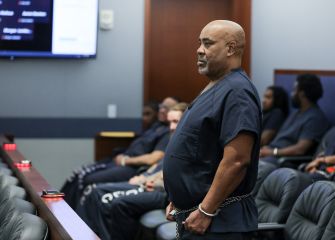
Jurors began deliberating Monday in the murder trial of Duane “Keffe D” Davis after prosecutors argued that his own words show he helped orchestrate the 1996 killing of Tupac Shakur and that his later attempts to distance himself from those accounts are not credible.
Chief Deputy District Attorney Binu Palal told the Las Vegas jury that Davis organized the attack as retaliation after Shakur and members of his entourage beat Davis’ nephew, Orlando “Baby Lane” Anderson, at the MGM Grand hours before the shooting.
“Duane Davis, in the culture of gangs, could not let that stand,” Palal said during closing arguments. He told jurors that Davis acquired a gun, assembled a group and “went hunting for Mr. Shakur.”
Davis, 63, has pleaded not guilty and is not accused of firing the shots that killed Shakur. Prosecutors instead contend that he supplied the weapon and helped organize the group that pursued the rapper through Las Vegas before the fatal drive-by shooting.
Under Nevada law, a person does not have to pull the trigger to be held responsible for a murder. Someone who knowingly aids or helps carry out the killing can be prosecuted as a participant in the crime.
That point is central to the state’s case because prosecutors have repeatedly relied on Davis’ own descriptions of what happened.
Jurors heard recordings in which Davis said he was riding in the white Cadillac that pulled alongside the BMW carrying Shakur and Death Row Records founder Marion “Suge” Knight on Sept. 7, 1996. Prosecutors also presented interviews and Davis’ 2019 memoir, Compton Street Legend, in which he described obtaining the gun and passing it toward the back seat before the shooting.
Palal told jurors that those statements were supported by evidence beyond Davis’ own accounts and rejected the defense argument that the prosecution had built its case almost entirely around stories Davis invented.
“It seems like you’ve been told that there’s nothing that exists outside of Mr. Davis’ statements, and that is simply not true,” Palal said, describing the case as supported by circumstantial evidence.
The prosecutor also questioned why Davis would fabricate a version of events that could expose him to a murder charge when he could have portrayed himself simply as a witness.
Defense attorney Michael Sanft offered a sharply different account, arguing that Davis spent years exaggerating his role in Shakur’s death for attention and money and that investigators never found enough independent evidence to prove his stories were true.
Sanft focused on the lack of physical evidence directly placing Davis at the shooting and on testimony from retired Las Vegas homicide detective Dan Long, who interviewed Davis during the investigation but said he was unable to verify several details Davis provided.
The defense has characterized Davis’ public accounts as bragging rather than reliable confessions and argued that prosecutors are now treating stories he told for publicity as proof of murder.
Davis did not testify during the trial.
The case has therefore left jurors with sharply competing explanations for the same statements: prosecutors say Davis repeatedly described his own role in a planned retaliation, while the defense says he created and embellished those accounts long after Shakur’s death.
Shakur was shot multiple times while riding with Knight near the Las Vegas Strip following a Mike Tyson fight. He died six days later at age 25.
Davis became the first and only person charged in the killing when a Clark County grand jury indicted him in September 2023, nearly 27 years after the shooting.
The trial included testimony from law enforcement officers, people connected to the Compton gang scene, and witnesses tied to the events surrounding the shooting. Prosecutors presented 27 witnesses over nine days before the defense called three witnesses of its own.
The state has never accused Davis of being the gunman. Its case asks jurors to decide whether his alleged role in obtaining the weapon, organizing the retaliation and participating in the pursuit of Shakur is enough to make him legally responsible for the killing.
Davis faces life in prison if convicted.
The 12-member jury began deliberations Monday after closing arguments concluded. No verdict had been announced as of publication.