Wisconsin election officials have referred two complaints involving Elon Musk’s $1 million payments to voters for possible criminal prosecution after finding probable cause to believe the offers violated the state’s election bribery law.
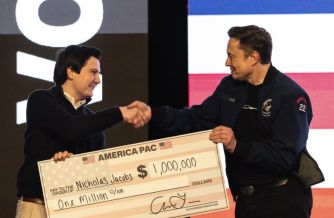
The Wisconsin Elections Commission voted 5 to 1 to send the complaints to the Brown County district attorney’s office. The commission’s approved motion states that Musk used a social media post to offer $1 million to people who had voted in the 2025 state Supreme Court election, allegedly to induce them to participate in the race.
The complaints were filed by voters in Milwaukee and Green Bay and remain confidential under state law. The Brown County district attorney’s office will decide whether the evidence supports criminal charges.
Musk distributed three $1 million checks to Wisconsin voters, including two presented at a Green Bay rally several days before the April 1 election. He and organizations he supported spent at least $20 million backing Brad Schimel, who was supported by Republicans. Susan Crawford, the candidate backed by Democrats, won the race by 10 percentage points.
Wisconsin Statute 12.11 bars a person from offering, giving, lending, or promising anything of value to induce a voter to go to the polls, vote, refrain from voting, or cast a ballot for or against a candidate or referendum. The law is broader than a ban on paying someone to support a particular candidate. It may also cover an offer meant to persuade an eligible voter to take part in an election at all.
The wording and purpose of Musk’s offer are central to the referral. The commission did not claim that the check recipients were required to vote for Schimel. Its motion instead focused on whether the offer was made to reward or encourage voting itself.
Money qualifies as something of value under the statute. A criminal case would still require prosecutors to prove that the offer carried the intent required by the law. If charges are filed, the state would have to establish that point beyond a reasonable doubt rather than rely only on the timing or size of the payments.
Musk’s attorneys have maintained that the payments were protected political expression under the Wisconsin and United States constitutions. Earlier court filings described the program as an effort to organize opposition to judges Musk viewed as activists, rather than an attempt to directly support or defeat a candidate.
The First Amendment gives broad protection to political speech, including spending used to communicate a political message. That protection does not automatically place every payment connected to political activity beyond election laws. A court reviewing the dispute would have to consider whether the payments were part of protected advocacy or an offer of money tied to electoral participation.
Election bribery laws are intended to prevent payments from influencing a voter’s choices or participation. Their reach can extend beyond an agreement to cast a ballot for a named candidate because turnout itself can affect an election. At the same time, enforcement must remain consistent with constitutional protections for organizing, petitioning, and speaking about public issues.
The commission’s probable cause finding does not establish that Musk committed a crime. It means the panel found enough support for the allegations to refer them to a prosecutor. The Brown County district attorney retains authority to decide whether the evidence supports criminal charges.
Wisconsin Attorney General Josh Kaul previously sought an emergency court order to block the distribution of two checks before the election. State courts declined to issue the requested order, but they did not decide whether the payments violated Wisconsin law.
A separate civil lawsuit brought by the Wisconsin Democracy Campaign and two voters is also pending in Brown County. The complaint alleges that Musk, America PAC, and another organization he funds violated state bans on vote bribery and unauthorized lotteries. It also raises claims of civil conspiracy and public nuisance and seeks an order preventing similar payments in future Wisconsin elections.
The civil case and the commission referral address overlapping conduct but seek different results. The watchdog group is asking a court to restrict future payment programs, while the commission’s action has placed the matter before a prosecutor who may pursue criminal enforcement.
Brown County prosecutors have 40 days from the referral to report back to the Wisconsin Elections Commission, and no charges have been filed.