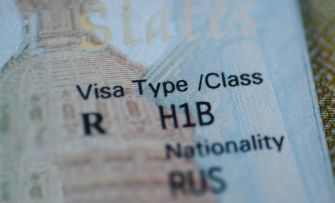
A federal judge in Massachusetts has struck down the Trump administration’s $100,000 fee for new H-1B visa petitions, ruling that the executive branch imposed a payment that functioned as a tax without approval from Congress.
In a ruling issued Monday, U.S. District Judge Leo T. Sorokin found that the administration exceeded its authority when it imposed the $100,000 payment requirement through a presidential proclamation signed in September 2025.
A coalition of 20 states, led by California and Massachusetts, challenged the policy, claiming it exceeded presidential authority and bypassed federal rulemaking requirements.
Under the H-1B visa program, U.S. employers may hire foreign workers in specialty occupations, a category that includes many jobs in technology, engineering, medicine, research and higher education. Employers usually sponsor workers for the visa and pay filing costs connected to the petition. H-1B workers are lawfully admitted to the United States for temporary employment, but they are not permanent residents.
President Trump signed Proclamation 10973 on September 19, 2025, adding the $100,000 payment requirement to new H-1B petitions. The administration said the measure was aimed at curbing abuse of the program and protecting American workers.
The states argued that Congress created the H-1B program, set the main rules for it, and decided which fees may be charged. They also claimed federal agencies violated the Administrative Procedure Act by carrying out the new fee without the required rulemaking process.
The court’s analysis centered on the difference between a government fee, a penalty, and a tax. Government fees are usually tied to the cost of providing a service, including application review. Penalties punish unlawful conduct. Taxes raise money or influence behavior through a required payment.
Sorokin concluded that the $100,000 H-1B charge fit the third category because it applied to a lawful visa program and was not tied to the cost of processing a petition. Relying partly on the Supreme Court’s 2012 Affordable Care Act (ACA)The Affordable Care Act (ACA), also known as Obamacare, is a federal health care law enacted in 2010 that expanded access to health insurance, created health insurance marketplaces and premium subsidies, expanded Medicaid in participating states, and established consumer protections for people with private health coverage.Read more → ruling, the judge said a required payment can be treated as a tax when it is not a punishment for illegal conduct.
Congress holds the constitutional power to collect taxes, and the ruling says the administration had not identified any immigration law clearly giving that power to the president.
Administration lawyers pointed to provisions of the Immigration and Nationality Act that allow the president to suspend or restrict the entry of some noncitizens. The court said those provisions address entry restrictions, not a new tax on employers filing H-1B petitions.
The court also rejected the administration’s argument that the dispute was largely beyond judicial review, finding that the states were challenging a broad agency-enforced policy rather than an individual visa denial.
The proclamation was carried out through materials issued by several federal agencies, including USCIS, the State Department, and Customs and Border Protection. DHS also created a payment website and updated its H-1B fee materials.
Federal agencies also faced a separate problem under the Administrative Procedure Act, which controls how agencies make many rules and often requires agencies to publish proposed rules, accept public comments, and explain final decisions before a new rule is adopted.
The judge said those materials went beyond announcing a presidential policy. Memoranda, online instructions, payment materials, and other guidance required employers to pay the $100,000 charge before filing covered H-1B petitions.
Existing immigration law allows DHS to charge adjudication fees to recover the cost of processing immigration services. The court found the $100,000 payment did not fit within that authority because the administration did not claim it was tied to processing costs.
Sorokin also ruled that the policy was arbitrary and capricious, an APA standard that requires agencies to explain major decisions and consider important consequences.
The states claimed the payment requirement would worsen shortages in education, public universities, research institutions, and health care systems. The court said the agencies did not adequately address those concerns or consider whether the charge should be narrowed for schools, universities, nonprofits, or health care employers.
A separate challenge to the fee, brought by the U.S. Chamber of Commerce and the Association of American Universities, was previously rejected by another federal judge and is now before an appeals court.
Sorokin denied the federal government’s bid to dismiss the states’ case and vacated the agency materials enforcing the $100,000 H-1B charge.
Share This Article
If you found this article insightful, consider sharing it with your network.
Law Commentary’s Staff Writers are dedicated legal professionals and journalists who excel at making complex legal topics accessible and relatable. They are committed to providing clear, accurate commentary that helps readers understand the impact of legal news on their daily lives.
A second federal judge has blocked President Donald Trump’s $100,000 fee on new H-1B visas, ruling that federal immigration officials bypassed required rulemaking procedures before putting the charge into effect.U.S. District Judge Haywood S. Gilliam Jr. of the Northern District of California issued the order Wednesday, September 30, blocking U.S....
Read
More »
The Trump administration is proposing to charge universities $70,000 for each international student they recommend for U.S. work authorization, with another $30,000 for subsequent participation, under a new immigration regulation that could sharply increase the cost of hiring foreign graduates.The Department of Homeland Security's proposal, published in the Federal Register...
Read
More »
The Trump administration has blocked Microsoft, Adobe, and six other major technology companies from a federal green-card sponsorship program, halting new applications and freezing pending cases as Vice President JD Vance accuses the companies of abusing the immigration system.Labor Secretary Keith Sonderling announced the suspensions on October 8, 2026, saying...
Read
More »
A federal judge blocked the Trump administration Monday from imposing new limits on how long foreign students, exchange visitors and journalists can remain in the United States, stopping the immigration rule one day before it was scheduled to take effect.U.S. District Judge F. Dennis Saylor IV in Massachusetts postponed the...
Read
More »
The Department of Homeland Security is proposing a new $103,265 fee for many H-1B visa petitions, less than three months after a federal judge struck down President Donald Trump’s separate $100,000 payment requirement.The proposed rule, published in the Federal Register on August 25, would impose the additional fee on H-1B...
Read
More »
We use cookies and similar technologies to help our website function, understand how visitors use our site, and improve your experience. Some cookies are necessary for the website to operate, while others may be used for analytics or advertising.