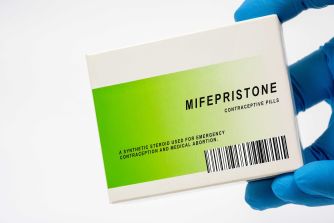
A federal appeals court is weighing another challenge to mifepristone, the medication used in most abortions in the United States, in a case that could affect whether patients can continue receiving the drug through telehealth and the mail.
The U.S. Court of Appeals for the Fifth Circuit heard arguments September 9 in a lawsuit brought by Louisiana challenging the Food and Drug Administration’s 2023 decision to remove an in-person dispensing requirement for mifepristone.
For patients, the dispute reaches well beyond the details of federal drug regulation. The rules at issue help determine whether someone must travel to a clinic, hospital, or medical office to obtain the medication or can receive it after consulting with a qualified provider remotely.
The judges spent much of the hearing examining a threshold legal question: whether Louisiana has standing to challenge the FDA’s decision in the first place.
The FDA’s current rules allow certified healthcare providers to prescribe mifepristone without a federally required in-person visit. Certified pharmacies can then dispense the drug, including by mail. Louisiana wants the court to restore an earlier requirement that mifepristone be dispensed in person at a clinic, medical office, or hospital.
Mifepristone is typically used with misoprostol to end an intrauterine pregnancy through 10 weeks. The FDA first approved mifepristone in 2000 and approved a generic version in 2019. Medication abortion now accounts for more than 60% of abortions in the United States.
Louisiana argues that the federal rules make it more difficult for the state to enforce its abortion restrictions because providers outside Louisiana can prescribe the medication remotely and send it to patients in the state.
Louisiana Solicitor General Benjamin Aguinaga told the Fifth Circuit that roughly 1,000 abortions each month involve mifepristone mailed into Louisiana. The state also argues that it incurs Medicaid costs when patients seek emergency treatment after medication abortions.
The FDA and mifepristone manufacturers Danco Laboratories and GenBioPro dispute Louisiana’s standing. Their attorneys argue that the connection between the FDA’s regulations and Louisiana’s claimed injuries depends on the independent actions of patients, out-of-state healthcare providers and states that have adopted abortion shield laws.
Judges Stephen Higginson and Dana Douglas questioned that connection during the hearing. Higginson focused in part on shield laws, which are intended to protect healthcare providers in states where abortion remains legal when they provide abortion-related services to patients living in states with bans or tighter restrictions.
Judge Priscilla Richman also questioned attorneys about emergency-room visits and whether an in-person examination before prescribing mifepristone could have prevented some complications.
The focus on standing is familiar territory in the long-running legal fight over mifepristone.
In 2024, the U.S. Supreme Court unanimously ruled in FDA v. Alliance for Hippocratic Medicine that a group of anti-abortion doctors and medical organizations lacked standing to challenge the FDA’s changes to mifepristone access. The justices did not decide whether the FDA’s actions themselves were lawful.
Louisiana is now trying to clear that same legal hurdle by claiming injuries suffered directly by the state.
An earlier Fifth Circuit panel accepted those arguments. On May 1, the court concluded that Louisiana had demonstrated standing based on alleged interference with its abortion laws and Medicaid expenses tied to emergency treatment. The panel temporarily stayed the FDA’s 2023 rules and found that Louisiana had made a strong preliminary showing that its challenge under the Administrative Procedure Act could succeed.
The Supreme Court stepped in shortly afterward.
On May 14, the justices stayed the Fifth Circuit’s order while the appeal continues, leaving the FDA’s current mifepristone rules in place. Justices Clarence Thomas and Samuel Alito dissented. The Supreme Court’s order is expected to remain effective throughout the Fifth Circuit appeal and during any timely request for further Supreme Court review.
For patients and providers, that means the rules will not suddenly change simply because the Fifth Circuit issues another decision. Even if Louisiana prevails at this stage, the Supreme Court’s stay provides continuity while the litigation continues.
The underlying dispute centers on the FDA’s Risk Evaluation and Mitigation Strategy, or REMS, for mifepristone.
REMS programs are used by the FDA when additional safety requirements are considered necessary for certain medications. Before the agency’s 2023 change, mifepristone generally had to be dispensed in person at a clinic, hospital, or medical office. The FDA later removed that requirement and created a certification system for pharmacies.
Under the current program, certified prescribers must meet specific qualifications, discuss the medication’s risks with patients, and make arrangements for appropriate medical care if complications arise. An in-person visit is not required under the federal rules.
Louisiana argues that the FDA did not adequately explain its decision to eliminate the in-person dispensing requirement and did not properly evaluate the available safety information. The earlier Fifth Circuit panel agreed, at least at the preliminary stage, that the state had shown a likelihood of succeeding on its argument that the agency acted arbitrarily and capriciously.
The FDA and the manufacturers disagree. They maintain that the agency reviewed the available evidence before modifying the program. The FDA continues to describe mifepristone as safe and effective when used according to its approved conditions.
The case is unfolding while the Trump administration conducts its own review of mifepristone’s safety and prescribing requirements. A Justice Department attorney told the Fifth Circuit that the FDA review remains underway and argued that questions about the drug’s restrictions should first move through the federal regulatory process.
Other states are pursuing related challenges. Texas and Florida have filed a separate case, while Idaho, Kansas, and Missouri are involved in litigation challenging federal mifepristone rules. Louisiana and Texas have also brought cases against out-of-state providers who relied on shield laws when prescribing abortion medication to patients in states with abortion bans.
Together, the cases are raising a difficult question in the post-Roe v. Wade landscape: what happens when the laws of the state where a patient lives conflict with the laws protecting the clinician who provides the care?
Telehealth makes that question more immediate. A patient can be in one state while the physician or other qualified provider is sitting in another. Medication can then cross state lines through the mail. State abortion restrictions, federal drug regulation, medical licensing, and shield laws can all come into play before the patient ever receives a prescription.
A Fifth Circuit ruling could clarify whether Louisiana has suffered the type of legal injury required to challenge the FDA’s rules. It could also send the mifepristone dispute back to the Supreme Court, this time with a state trying to establish the standing that was missing in the Court’s 2024 case.
For now, patients continue to have access under the FDA’s existing federal rules. Mifepristone can still be prescribed without a federally required in-person visit and dispensed by certified pharmacies through the mail while the courts continue to determine how far states can go in challenging those rules.