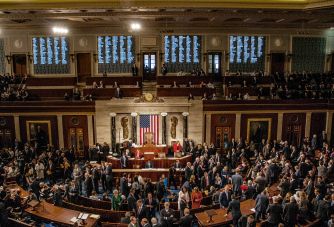
The House voted Tuesday for the third time to end U.S. military involvement in the war with Iran, with seven Republicans joining Democrats to direct President Donald Trump to remove American forces from hostilities against the country.
The 220 to 204 vote on September 15 drew the largest Republican support yet for a House effort to curtail Trump's authority over the nearly seven-month conflict. GOP Reps. Tom Barrett of Michigan, Warren Davidson of Ohio, Brian Fitzpatrick of Pennsylvania, Thomas Massie of Kentucky, Nancy Mace of South Carolina, Mariannette Miller-Meeks of Iowa and Zach Nunn of Iowa voted with Democrats.
Mace, Miller-Meeks and Nunn joined the effort for the first time, increasing Republican support from the four GOP lawmakers who backed the previous House resolutions.
Introduced by Democratic Rep. Seth Moulton of Massachusetts, House Concurrent Resolution 93 directs the president to remove U.S. Armed Forces from hostilities against Iran unless Congress declares war or specifically authorizes military force. It allows forces to remain when needed to defend the United States or an ally or partner from an imminent attack.
Senate approval would be required before Congress could invoke the withdrawal mechanism in the War Powers Resolution. H.Con.Res.93 is a concurrent resolution, meaning it must pass both chambers but would not be presented to the president for a signature or veto.
Even approval by both chambers would leave a major legal question over whether Congress can force a president to withdraw U.S. forces through that mechanism.
The Congressional Research Service has said the constitutional validity of that section of the War Powers Resolution is doubtful following the Supreme Court's 1983 decision in INS v. Chadha. The ruling found that congressional actions carrying the force of law generally must clear both chambers and be presented to the president. The Supreme Court did not specifically decide the validity of the War Powers provision, leaving the issue unresolved.
Tuesday's vote came as the financial cost of the Iran war continues to climb. The nonpartisan Congressional Budget Office estimated that military operations had cost the Defense Department about $38 billion through August 1 and could add roughly $2 billion to $3 billion for each additional month of fighting, depending on its intensity.
Replacing munitions accounts for a significant share of that expense. CBO estimated that replenishing weapons already used would cost about $21.7 billion and warned that heavy use of missile interceptors could leave some U.S. inventories reduced for several years.
The war began on February 28 and has continued through periods of reduced fighting and an earlier ceasefire. U.S. Central Command has maintained tens of thousands of personnel across the Middle East while American forces have carried out additional strikes against Iran.
The House vote now shifts the war powers fight back to the Senate. Senators have agreed to consider a separate House-passed Iran resolution, H.Con.Res.89, no later than October 2, setting up another vote over whether Congress can force an end to U.S. involvement in the conflict.