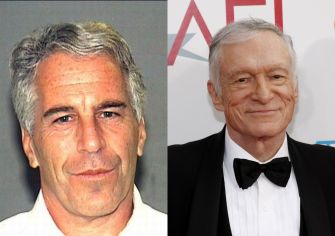
A group of Jeffrey Epstein survivors suing the federal government claims Playboy founder Hugh Hefner repeatedly contacted the FBI in 2005 after former Playmate Audra Christiansen told him she had been raped and trafficked by Epstein, adding a new allegation to a broader negligence case over the bureau’s handling of warnings about the financier.
Christiansen, who was 23 at the time, told Hefner about the alleged abuse while she was living at the Playboy Mansion in California, according to the amended complaint. She asked Hefner to contact federal authorities because she believed his name and connections would make the FBI more likely to take her account seriously. The filing claims Hefner called the agency multiple times on her behalf.
The survivors allege the FBI agreed to assist Christiansen and investigate her claims but failed to follow up for about 15 years. Federal agents contacted her in October 2020, according to the filing, more than a year after Epstein died while awaiting trial on federal sex trafficking charges and three years after Hefner’s death.
Christiansen claims Epstein raped her and trafficked her over a period of years. Her allegations are now part of a federal lawsuit accusing the United States of negligence over what the survivors describe as repeated failures by FBI personnel to act on information about Epstein’s abuse. The case also cites other alleged warnings to federal authorities, including a report made by Maria Farmer in 1996.
In April, U.S. District Judge David S. Leibowitz dismissed an earlier version of the complaint without prejudice, allowing the women to amend their allegations. He found that the filing had not identified enough facts showing a comparable situation in which a private person or organization could be held liable under Florida negligence law.
That requirement comes from the Federal Tort Claims Act, which allows certain lawsuits against the United States for negligence by federal employees. The federal government is generally protected from lawsuits by a principle known as sovereign immunity, but Congress created limited exceptions through the FTCA. To bring a negligence claim under the law, a person generally must point to comparable conduct that could make a private party liable under applicable state law.
One theory discussed in the April ruling is known as a voluntary undertaking. Under Florida negligence law, a person or organization that chooses to take on a responsibility can face liability in some circumstances if the work is handled negligently and another person reasonably relies on the promised help. The rule applies broadly and does not automatically create liability whenever someone agrees to provide assistance.
Leibowitz found that the earlier complaint did not allege enough specific facts showing that federal agents undertook such a responsibility and that someone relied on a promise that the FBI would act. The court also pointed to a lack of detail about what information was given to agents and what assurances, if any, were made in response.
The amended complaint now provides more detail about Christiansen’s alleged interaction with the FBI, including the claim that the bureau agreed to assist her and investigate after Hefner made contact on her behalf. Whether those allegations are enough to establish a legal duty under Florida law has not been decided by the court.
The government has also argued that decisions about whether and how to investigate reports are protected under an FTCA exception covering certain discretionary government decisions. Leibowitz declined to dismiss the earlier complaint on that basis, finding that the survivors had sufficiently alleged that mandatory FBI policies may have governed some of the conduct they challenged.
The United States continues to seek dismissal of the amended lawsuit and disputes that the alleged investigative failures create liability under the Federal Tort Claims Act.