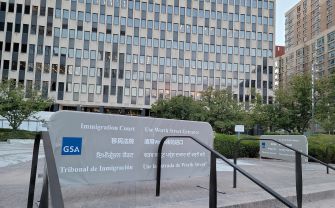
A federal judge has permanently ordered U.S. Immigration and Customs Enforcement to change detention conditions at 26 Federal Plaza in Manhattan, finding that ICE subjected people held there to “inhumane and unconstitutional” treatment and extending the order to all current and future detainees.
U.S. District Judge Lewis A. Kaplan issued the final ruling Thursday after a May bench trial examining overcrowding, sanitation, medical care and access to attorneys at the Lower Manhattan facility. He also granted final class certification covering every person currently held or later detained there, expanding a provisional class that had been limited to people held for at least 12 hours.
“ICE knew, or should have known, that how it was treating detainees was wrong, yet it continued to do it anyway,” Kaplan wrote.
The judge found that ICE confined people in overcrowded holding rooms for far longer than the spaces were designed to accommodate, depriving detainees of sleep, sanitary conditions, basic hygiene, sufficient food and water and adequate medical care. He concluded that the treatment served a punitive purpose and was intended in part to induce detainees to leave the United States voluntarily.
During periods of severe crowding in the summer of 2025, detainees sometimes tried to sleep sitting upright because there was not enough floor space to lie down, according to evidence examined by the court. Others slept beside toilets separated from the rest of the room by partial walls. The holding area had no beds or showers, and detainees described bright fluorescent lighting remaining on overnight.
Internal ICE communications introduced during the litigation showed officials raising concerns about the conditions themselves.
“This is insane,” one ICE employee wrote in an email about overcrowding, adding that the agency desperately needed to move detainees out of 26 Federal Plaza.
Medical problems also appeared in internal messages. Nancy Zanello, an assistant field office director for ICE in New York, wrote during the summer of 2025 that the facility had experienced “one gross contagion after another.” Trial evidence included concerns about tuberculosis, mpox and detainees requiring hospital treatment.
Kaplan found that ICE created the conditions by placing far more people in the holding rooms than intended and keeping them there beyond the short periods for which the facility was designed.
The final class now covers detainees from the time they are held at 26 Federal Plaza. People who spend only a few hours inside the facility receive the same protections as those held overnight or for longer periods.
ICE must provide at least 50 square feet of qualifying floor space per detainee, excluding areas immediately surrounding toilets, and generally keep holding rooms between 68 and 74 degrees.
Anyone held overnight must receive a clean sleeping mat or mattress, pillow and blanket. Lights must be dimmed during overnight hours, while detainees must receive three meals a day with bottled water and adequate supplies of soap, toilet paper and oral and feminine hygiene products.
The order also requires a licensed medical professional to remain on site and directs ICE to provide basic medical screenings before detainees enter the holding rooms so acute and chronic medical conditions can be identified and treatment can begin.
Kaplan imposed stronger requirements for access to attorneys after finding that detainees had been severely restricted in their ability to communicate confidentially with lawyers. ICE must provide each detainee an opportunity to make a free, confidential and unmonitored telephone call to an attorney or prospective attorney within one hour of arriving at the facility.
The case began in August 2025 after Sergio Alberto Barco Mercado sued federal officials following his detention at 26 Federal Plaza. Kaplan first imposed emergency restrictions and later entered a preliminary injunction setting capacity limits and requiring bedding, hygiene supplies, meals, medical care and private access to attorneys.
The court battle continued over ICE’s compliance with those orders. Evidence presented at trial showed that capacity limits were exceeded after the restrictions took effect, while Kaplan found that officials at times provided inaccurate information about conditions inside the facility.
He described ICE’s violations of the capacity requirements as “persistent, egregious” and at least reckless, and found that officials had sometimes intentionally concealed or recklessly disregarded the truth in representations to the court.
Kaplan also criticized the agency’s broader record of compliance. Although his earlier orders reduced crowding and improved some conditions, he found that ICE had followed the court’s directives selectively while continuing to disregard parts of them.
Government attorneys argued at the May trial that conditions had improved enough to make permanent restrictions unnecessary. They pointed to lower occupancy, regular cleaning, increased meal service and round-the-clock nursing coverage as evidence that ICE was complying with the preliminary injunction.
Kaplan concluded that the improvements occurred under court supervision and that the history of violations supported keeping enforceable standards in place.
The permanent injunction allows ICE to continue using 26 Federal Plaza as a short-term holding facility while requiring the agency to meet court-ordered standards for crowding, sleeping conditions, sanitation, food, medical care, and access to lawyers.
Those requirements now apply to every current and future immigration detainee held at the facility.