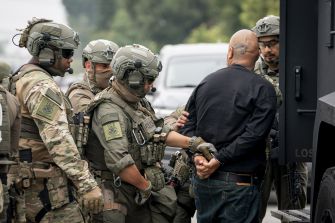
A federal judge has blocked immigration officers from making warrantless civil arrests across seven Southern California counties unless they first determine that a person is likely to escape before a warrant can be obtained.
U.S. District Judge Maame Ewusi-Mensah Frimpong granted the preliminary injunction Sept. 2. The order covers Los Angeles, Orange, Riverside, San Bernardino, Ventura, Santa Barbara and San Luis Obispo counties.
Records produced during the case became central to the ruling. Lawyers for the plaintiffs reviewed files tied to 113 warrantless arrests and said 89, nearly 80%, either contained no escape-risk assessment or relied on substantially similar language to justify the arrest.
Under the order, immigration officers must consider the circumstances known to them before making an arrest and document specific facts supporting probable cause that the person is likely to escape. Frimpong ruled that unlawful presence in the United States alone cannot establish that risk.
The judge wrote that federal officers were “regularly abstaining” from conducting the required analysis and found evidence that the disputed arrests reflected an ongoing government practice rather than isolated decisions by individual agents.
Frimpong also cited video that appeared to conflict with written accounts of some arrests. In one case, immigration agents said a car wash worker was likely to escape because he had fled from law enforcement. Video showed the man remaining in the same area until an agent called him over, according to the ruling.
The injunction also addresses a January 2026 ICE memorandum concerning warrantless arrests. Officers must base an escape-risk finding on the circumstances surrounding the individual arrest rather than treating a person's unlawful immigration status as sufficient justification on its own.
Justice Department lawyers disputed the plaintiffs' characterization of the government's practices. Federal attorney Daniel Mummolo argued during an August hearing that no written or unwritten policy authorizing unlawful warrantless arrests existed and said agents have flexibility in making escape-risk determinations in the field.
Mummolo also challenged the plaintiffs' reading of the arrest records, maintaining that the “overwhelming majority” included some discussion of flight risk and arguing that agents were not required to document the assessment.
Frimpong concluded that two plaintiff organizations were likely to show that the government was following an unlawful policy. The finding is preliminary, and whether the challenged practices ultimately violated federal law will be decided as the case proceeds.
The court also certified a class covering people who have been or will be arrested by federal immigration officers in the district without a warrant and without an individualized escape-risk assessment, dating back to June 6, 2025.
The lawsuit was filed by workers and immigrant advocacy organizations represented by the ACLU of Southern California, Public Counsel and other attorneys amid expanded federal immigration enforcement in the Los Angeles region.
The broader case previously reached the U.S. Supreme Court over separate restrictions on immigration stops involving factors including apparent ethnicity, language, location and occupation. The justices stayed those restrictions in September 2025 while the litigation continued.
Frimpong denied the government's request to delay the new injunction while federal officials considered an appeal, leaving the warrantless arrest restrictions in effect as the case moves forward.