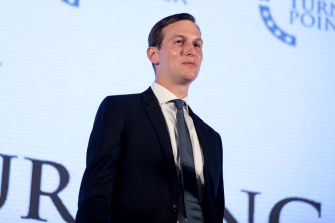
A federal lawsuit seeks to block Jared Kushner, President Donald Trump's son-in-law, from serving as a top U.S. diplomatic envoy, alleging that he has exercised government authority without Senate confirmation while maintaining billions of dollars in foreign-backed investments.
Citizens for Responsibility and Ethics in Washington (CREW) filed the 45-page complaint on October 14, 2026, in the U.S. District Court for the District of Columbia. The watchdog group argues that Kushner's role in major international negotiations subjects him to constitutional appointment requirements and federal financial disclosure laws.
The lawsuit also names special envoy Steve Witkoff, White House Chief of Staff Susie Wiles, Secretary of State Marco Rubio, and Defense Secretary Pete Hegseth in their official capacities.
Under the Constitution's Appointments Clause, principal federal officers must be nominated by the president and confirmed by the Senate, while certain lower-ranking officials may be appointed through other procedures. CREW contends that Kushner's continuing negotiations with foreign leaders and involvement in major foreign policy decisions make him a federal officer, regardless of his volunteer status.
Kushner has worked alongside Witkoff on several of the administration's most prominent foreign policy negotiations. He helped negotiate the October 2025 ceasefire agreement between Israel and Hamas and has participated in diplomatic efforts involving Russia, Ukraine and Iran, meeting directly with foreign leaders on the administration's behalf.
Those assignments have drawn scrutiny because of his financial interests abroad. Kushner runs Affinity Partners, an investment firm managing more than $6 billion in assets, approximately 99% of which are owned by foreign investors, according to CREW. Those investors include sovereign wealth funds from Saudi Arabia, Qatar and the United Arab Emirates, while the firm also holds investments in Israel.
CREW argues that Kushner's financial interests overlap with his diplomatic responsibilities, raising potential conflicts that federal disclosure requirements are intended to reveal. The Ethics in Government Act requires certain senior officials, including those serving without pay, to publicly report their income, investments and other financial interests. According to the complaint, Kushner has filed no such disclosures during Trump's second administration, prompting the organization to seek a court order requiring them.
Kushner's attorney, Chad Mizelle, rejected the allegations, calling the lawsuit meritless. He said outside ethics counsel and government ethics attorneys had reviewed Kushner's volunteer service and determined that the arrangement complies with applicable requirements.
White House spokeswoman Anna Kelly also defended Kushner, saying he serves at Trump's request, covers his own expenses and keeps his business activities separate from his diplomatic work. Kushner has previously argued that his international business relationships strengthened his diplomatic efforts. During a 2025 CBS News interview, he credited those connections with helping secure the release of Israeli hostages held by Hamas.
His current arrangement differs from his position during Trump's first administration, when he served as a formal White House senior adviser. Kushner and his wife, Ivanka Trump, were government employees and filed public financial disclosures despite receiving no salaries. His responsibilities at the time included domestic policy initiatives and diplomatic negotiations in the Middle East.
The complaint also argues that allowing Kushner to exercise federal authority as a private citizen violates constitutional limits on delegating government powers, a separate claim that could remain at issue even if the court rejects CREW's Appointments Clause argument.
Mizelle has also challenged CREW's legal standing to sue, arguing that the organization has no right to pursue the case. CREW maintains that Kushner's failure to file financial disclosures deprives it of government records it is legally entitled to obtain. The court may have to resolve that dispute before considering the constitutional claims.