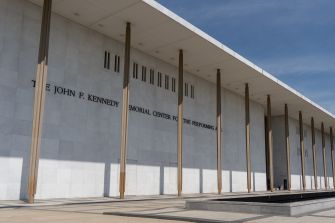
A federal judge has again blocked efforts to place President Donald Trump’s name on the Kennedy Center, ruling that the board overseeing the performing arts institution cannot rename the building, its grounds or its public spaces without approval from Congress.
U.S. District Judge Christopher Cooper issued the ruling Tuesday, September 15, rejecting a new proposal from the Kennedy Center’s board to recognize Trump on the building’s exterior and rename the surrounding grounds the “President Donald J. Trump Plaza.”
The board had proposed adding language to the Kennedy Center stating that it was “Restored and Renovated by President Donald J. Trump.” Cooper concluded that the new wording still conflicted with federal law and with an earlier court order requiring Trump’s name to be removed from the building.
“Simply put,” Cooper wrote, the board cannot install memorials honoring Trump or anyone else at the Kennedy Center without Congress authorizing it.
Congress designated the John F. Kennedy Center for the Performing Arts as the nation’s performing arts center and as a “living memorial” to President John F. Kennedy. Federal law also identifies the institution as the sole national memorial to Kennedy in Washington and the surrounding area.
Another provision sharply limits the installation of additional memorials or memorial-style plaques in the center’s public spaces. Cooper relied on those restrictions when he first ruled in May that the board had exceeded its authority by adding Trump’s name to the center.
The earlier renaming had produced a new title combining Trump’s and Kennedy’s names. Cooper ordered the change undone, and Trump’s name was removed from the building and official materials in June.
The Kennedy Center board returned to the issue in August with a different approach.
Rather than formally combining the two presidents’ names, the board voted to add an inscription crediting Trump with restoring and renovating the building. It also approved the proposal to rename the grounds in his honor.
The administration argued that the language would recognize Trump’s contribution to the center rather than change the institution’s official name. Supporters compared the proposal to donor recognition commonly seen at universities, hospitals and cultural institutions.
Cooper was not persuaded by that distinction.
His ruling concluded that Congress had reserved decisions involving public memorials at the center for itself. Calling the proposed language an acknowledgment rather than a renaming did not give the board authority that Congress had never granted it.
The lawsuit was brought by Rep. Joyce Beatty of Ohio, a Democratic member of the Kennedy Center board who challenged the earlier renaming and then returned to court when the board approved the new proposals.
The legal question in both rounds of the case has been relatively narrow.
The Kennedy Center board has substantial authority to operate the institution. It manages programming, finances, maintenance, and many other aspects of the performing arts center.
Congress also placed limits on that authority.
Federal law specifically directs the board to maintain the Kennedy Center as a living memorial to John F. Kennedy. Cooper has interpreted that language, together with restrictions on additional public memorials, to mean that the board cannot use its general management powers to honor another president on the building or grounds without congressional approval.
The latest ruling arrives as the Kennedy Center faces a far more immediate problem: the condition and future of the building itself.
The center has reported serious infrastructure and financial problems, and Trump and board members have argued that major renovations are necessary to keep the institution operating safely.
Commerce Secretary Howard Lutnick recently released security footage showing part of a ceiling collapsing during a rainstorm. No one was injured, but the incident added urgency to concerns about the aging building.
Board members have argued that Trump’s support is important to securing the money needed for repairs. Reuters reported that some trustees viewed public recognition of Trump’s role as central to raising funds for the project.
Hours after Cooper’s ruling Tuesday, the Kennedy Center board voted to close the main building for extensive renovations, according to Reuters and the Associated Press. The closure could last as long as two years while structural and infrastructure work is completed.
That creates an unusual moment for one of Washington’s most recognizable cultural institutions.
The people running the Kennedy Center say the building needs substantial investment. The court has made clear that necessary repairs can move forward. What the board cannot do, under Cooper’s interpretation of federal law, is make recognition of another president part of the center’s permanent public identity without going back to Congress.
Cooper has also tried to separate the renovation dispute from the naming fight.
His earlier rulings did not prevent the board from repairing the building or seeking funding. The court’s concern has been with actions that alter the memorial character Congress established for the center. It is a theater complex where musicians, dancers, actors, and audiences gather. It is also a federally created memorial with a name and purpose written into law.
Most private institutions can decide for themselves whose names appear on their buildings. The Kennedy Center does not have the same freedom because Congress defined what the institution is meant to commemorate.
Trump and the Kennedy Center board can appeal Cooper’s ruling, and the administration has already challenged his earlier decision.
Congress could also change the result directly.
Because Congress established the center’s name and memorial status by statute, lawmakers could pass legislation authorizing another name, inscription or memorial. Cooper’s ruling rests on the conclusion that the board cannot make that change by itself.
For now, the result is clear.
The Kennedy Center will remain legally and publicly dedicated to John F. Kennedy unless Congress decides otherwise. Trump’s name cannot be added to the building, grounds, or plaza under the board’s current proposals, even as the institution moves toward one of the largest renovation projects in its history.