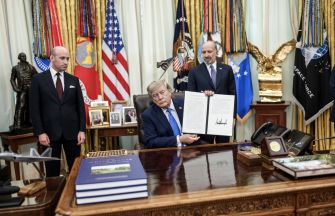
Photo Source: The White House/Official White House Photo by Molly Riley
A federal judge in Maryland has blocked the Trump administration from applying President Donald Trump’s latest birthright citizenship order to a class of U.S.-born children, finding that the Supreme Court already settled their constitutional right to citizenship earlier this year.
U.S. District Judge Deborah L. Boardman issued a preliminary injunctionA preliminary injunction is a temporary court order issued before a case is finally decided that requires a party to take or stop an action while the litigation continues. Federal courts generally consider the likelihood of success, irreparable harm, the balance of equities, and the public interest before granting one.Read more → Wednesday, September 2, preventing federal agencies from enforcing Trump’s August 6 executive order against children covered by an existing class-action lawsuit. Boardman said the new order is “almost certainly unconstitutional” as applied to the class because the Supreme Court ruled June 30 that children born in the United States to parents who are unlawfully or temporarily in the country are citizens at birth.
“The Supreme Court has spoken,” Boardman wrote. She said no presidential executive order can undo the Court’s determination that the children covered by the lawsuit satisfy the requirements of the Citizenship Clause of the Fourteenth Amendment.
The ruling marks a significant change from Boardman’s decision just days earlier. On August 28, she declined to immediately block the new executive order because the plaintiffs’ existing complaint challenged Trump’s earlier 2025 birthright citizenship order, not the replacement issued this summer.
Boardman allowed the plaintiffs to supplement their lawsuit that same day. They quickly filed an amended challenge to the August 6 order and renewed their request for an injunction. After reviewing the new claims, Boardman concluded that the plaintiffs were highly likely to succeed on their constitutional challenge.
Trump issued Executive Order 14418, titled “Continuing to Protect the Meaning and Value of American Citizenship,” on August 6, approximately five weeks after the Supreme Court rejected his administration’s broader attempt to restrict birthright citizenship.
The new order sought to identify narrower categories of children whom the administration contends fall outside the Fourteenth Amendment’s citizenship guarantee. It directs federal agencies not to recognize citizenship when neither parent is a U.S. citizen, and certain additional conditions apply.
Among them are children whose parents are classified as “alien enemies,” children of certain foreign government employees, and children whose parents allegedly engaged in fraud or a commercial transaction intended to obtain birthright citizenship. The order specifically includes arrangements in which parents pay for travel or other services intended to ensure that a mother is in the United States when she gives birth.
The administration described the latter category as an effort to curb “birth tourism,” in which foreign nationals travel to the United States to give birth so their children receive American citizenship.
Boardman found that the administration’s new categories do not resolve the central constitutional problem for children already covered by the lawsuit.
The certified class includes children born in the United States after February 19, 2025, whose mothers were unlawfully present and whose fathers were neither U.S. citizens nor lawful permanent residents, as well as children whose mothers were lawfully but temporarily present and whose fathers lacked citizenship or permanent resident status.
That class is effectively identical to one involved in Trump v. Barbara, the Supreme Court case decided June 30.
In that 6-3 decision, the Supreme Court held that children born in the United States to parents who are unlawfully or temporarily present are “subject to the jurisdiction” of the United States and therefore citizens at birth under the Fourteenth Amendment. The Court said the constitutional rule is broad and carries only narrow historical exceptions, including children of certain foreign diplomats and children born to enemies occupying U.S. territory.
Trump’s new order relies on language from the Supreme Court decision concerning those exceptions. The administration argues that additional categories of children may fall outside the citizenship guarantee when circumstances create what the order calls an “extraterritorial fiction.”
Boardman rejected that reasoning as a basis for denying citizenship to members of the certified class.
She wrote that even a preliminary review of the new order showed that several of its proposed exceptions bore “little to no resemblance” to the narrow historical exceptions recognized by the Supreme Court.
Her ruling did not resolve every possible constitutional question raised by the August order. Instead, Boardman focused on the narrower question of whether the administration could apply it to children whom the Supreme Court had already determined are citizens.
She concluded it could not.
Justice Department attorneys had argued that the lawsuit was premature because federal agencies had not yet issued detailed guidance explaining how the new order would be enforced. The executive order gives agencies 30 days to publish implementation guidance.
Boardman rejected that argument, reasoning that the executive order itself directs agencies to deny citizenship documents to broad categories of children regardless of what the forthcoming guidance ultimately says.
The implementation issue has already taken on practical significance.
Reuters reported this week that the State Department had drafted guidance that could require parents applying for passports for U.S.-born children to provide documents showing their own citizenship or immigration status. The proposal was designed in part to determine whether a child falls within one of the categories established by Trump’s August order.
Boardman’s injunction prevents the State Department, Department of Homeland Security, Social Security Administration and other federal defendants from enforcing the August order against members of the certified class or otherwise refusing to recognize their citizenship.
The ruling has limits.
Boardman did not prohibit federal agencies from issuing the implementation guidance required by the executive order. She also left untouched a provision addressing people born in U.S. territories or territorial waters where citizenship is not granted by federal statute because that provision does not affect members of the class before her.
The preliminary injunction also does not amount to a final ruling invalidating every provision of Trump’s August order for every person who might be affected. Boardman expressly limited her decision to the certified class and said she did not need, at this stage, to decide the constitutionality of each individual exception claimed by the administration.
Even so, her reasoning presents a substantial obstacle to the administration’s renewed attempt to narrow birthright citizenship.
The Fourteenth Amendment states that all people born or naturalized in the United States and “subject to the jurisdiction thereof” are citizens. In Trump v. Barbara, the Supreme Court concluded that children born here to parents unlawfully or temporarily present generally fall within that language.
Boardman said the August executive order cannot remove citizenship from children already protected by that decision simply by assigning them to newly defined categories.
The case now returns to litigation over the administration’s revised policy, less than three months after the Supreme Court appeared to resolve the central constitutional dispute surrounding Trump’s original birthright citizenship order.
For families potentially affected by the new policy, Wednesday’s ruling means federal agencies may not use the August order to deny citizenship recognition to children who fall within the certified class while the lawsuit continues. The broader question of how much of Trump’s revised order can survive outside that class remains unresolved.
Share This Article
If you found this article insightful, consider sharing it with your network.
Lawrence is an attorney and CEO of Law Commentary. His legal background includes corporate and general business law, litigation, transactional matters, and law practice management. His litigation experience has included complex matters involving antitrust, insurance bad faith, and medical malpractice. On the transactional side, Lawrence has worked with buy-sell agreements, Regulation D disclosures, stock option plans, and business matters. Lawrence draws on his legal and business experience to help make court decisions, litigation, legislation, public policy, and other legal developments more accessible to the general public and to give readers clear context for understanding the law and how it affects businesses, consumers, and communities.
President Donald Trump’s new order restricting birthright citizenship remained in effect Friday after a federal judge declined to immediately block it, while raising questions about whether the president can create new citizenship exceptions following a recent Supreme Court ruling.U.S. District Judge Deborah Boardman in Maryland denied immigrant-rights advocates’ request for...
Read
More »
A federal judge blocked the Trump administration Monday from imposing new limits on how long foreign students, exchange visitors and journalists can remain in the United States, stopping the immigration rule one day before it was scheduled to take effect.U.S. District Judge F. Dennis Saylor IV in Massachusetts postponed the...
Read
More »
The Trump administration is proposing that parents applying for U.S. passports for their children provide proof of their own citizenship or immigration status, a new requirement tied to President Donald Trump’s latest effort to restrict birthright citizenship.Draft State Department guidance would require parents or legal guardians to submit documents showing...
Read
More »
A federal judge has struck down a Trump administration policy blocking immigrant visas for nationals of 75 countries, ruling that the State Department could not require otherwise eligible applicants to be denied based on nationality alone.U.S. District Judge Jeannette A. Vargas of the Southern District of New York issued the...
Read
More »
President Donald Trump signed two executive orders Thursday seeking to deny birthright citizenship to children in several defined groups and increase enforcement against foreign visitors who travel to the United States to give birth.The action marks a narrower attempt to limit citizenship at birth after the Supreme Court rejected Trump’s...
Read
More »
We use cookies and similar technologies to help our website function, understand how visitors use our site, and improve your experience. Some cookies are necessary for the website to operate, while others may be used for analytics or advertising.