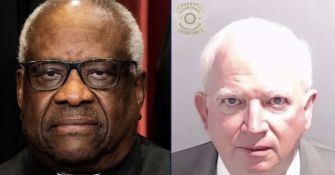
Photo Source: Clarence Thomas (Photo by Erin Schaff/Pool/Getty Images), John Eastman (Fulton County Sheriff’s Office)
On Monday, Supreme Court Justice Clarence Thomas recently recused himself from a case related to the January 6, 2021, attack on the U.S. Capitol. John Eastman, a former legal adviser to then-President Donald Trump and a former law clerk to Justice Thomas, brought forth the case. This marks a significant departure for Thomas, who had previously participated in a related case and had been criticized for not recusing himself.
Under United States law, federal judges, including Supreme Court justices, are obligated to recuse themselves when they previously participated in a case or have a financial interest in it or when a close relative is involved. A judge is also ethically obligated to do so “in any proceeding in which his impartiality might reasonably be questioned.” But that is subjective and open to interpretation.
Justice Thomas had been under scrutiny for his involvement in a previous case concerning the January 6 attack. In that case, he was the lone justice to signal support for Trump's legal arguments against the release of White House documents to the House committee investigating the events of January 6.
Judges are obligated to recuse themselves when their participation would create even the appearance of a conflict of interest. A person with an ounce of commonsense could see that the bar is met here.
— Sen. Ron Wyden, D-Ore.
Senator Ron Wyden (D-Ore.) said then that Thomas should not participate in any future cases about the January 6 investigation or the 2024 election, should Trump decide to run again. Wyden said, “Judges are obligated to recuse themselves when their participation would create even the appearance of a conflict of interest. A person with an ounce of commonsense could see that the bar is met here.”
This time, however, Thomas chose to step aside, not explaining his decision, as is customary for Supreme Court justices when they recuse themselves.
The case in question centered on John Eastman's efforts to prevent Chapman University, his former employer, from releasing archived emails related to him. These emails were of interest to the now-defunct January 6 committee. Eastman, a former law professor, had argued that then-Vice President Mike Pence had the authority to refuse to certify the 2020 presidential election results—an argument that has since been discredited.
Justice Thomas has faced ethical questions for not recusing himself from previous cases related to January 6, mainly because his wife, Virginia "Ginni" Thomas, is a conservative political activist who supported Trump's efforts to overturn the election. The recusal in the Eastman case may also be linked to the fact that some of the emails in question reportedly mentioned Thomas as the justice most likely to be receptive to Trump's arguments.
While the case was effectively moot before reaching the Supreme Court, as the committee had already obtained the relevant emails, the recusal raises questions about the ethical standards that justices should adhere to, especially when they have personal or professional connections to the parties involved. Eastman is facing disbarment proceedings in California and has been indicted concerning efforts to overturn the 2020 election results in Georgia.
Justice Clarence Thomas's decision to recuse himself from the case involving his former clerk, John Eastman, adds another layer to the ongoing discussions about judicial ethics and the Supreme Court's role in politically charged issues, and the actions of justices like Thomas will remain under scrutiny.
Share This Article
If you found this article insightful, consider sharing it with your network.
Lawrence is an attorney with experience in corporate and general business law, complemented by a background in law practice management. His litigation expertise spans complex issues such as antitrust, bad faith, and medical malpractice. On the transactional side, Lawrence has handled buy-sell agreements, Reg D disclosures, and stock option plans, bringing a practical and informed approach to each matter. Lawrence is the founder and CEO of Law Commentary.
A federal judge has reluctantly dismissed the final prosecution arising from the Jan. 6, 2021, attack on the U.S. Capitol after the Justice Department obtained the removal of eight Oath Keepers’ convictions and asked to abandon the charges.U.S. District Judge Amit Mehta granted the government’s request on August 4 and...
Read
More »
While the nation continues to bemoan questionable behavior by United States Supreme Court Justices Clarence Thomas, Samuel Alito and Sonia Sotomayor, the California Supreme Court is actually doing something to prevent its judges from unethical actions.
The California Supreme Court Committee on Judicial Ethics issued a Formal Opinion on August...
Read
More »
Sen. Lindsey O. Graham, a Republican from South Carolina, had made a request to the Supreme Court that he would not have to testify to a Georgia grand jury about an investigation into alleged efforts to overturn the results of the 2020 presidential election. An order of the court refused...
Read
More »
The State Bar of California has filed 11 disciplinary charges against John Charles Eastman, one of the chief legal advisors to ex-President Donald J. Trump regarding the outcome of the 2020 U.S. presidential election. The allegations assert that Eastman “engaged in a course of conduct to plan, promote, and assist”...
Read
More »
The week of February 8th will mark the beginning of the second Senate trial to impeach former President Donald Trump. The last trial ended with the Senate voting in favor of the then-sitting President. The political landscape changed over the previous year, though. Not only do more Democrats now hold...
Read
More »