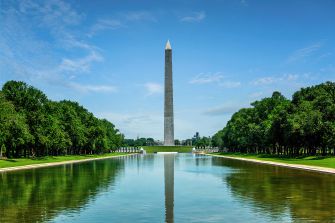
The Justice Department has asked a Washington, D.C., judge to dismiss the felony case against a former U.S. Olympian accused of damaging the Lincoln Memorial Reflecting Pool, saying newly obtained records show the pool’s coating failed because of a rushed and flawed installation rather than vandalism.
Prosecutors filed the motion July 31 in D.C. Superior Court, less than a month after a grand jury indicted David “Davey” Hearn, 67, of Bethesda, Maryland. The former Olympic canoeist had pleaded not guilty to one count of felony destruction of property.
The government is seeking dismissal without prejudice, which would allow prosecutors to bring the charge again if new evidence emerges. The filing was made under Rule 48 of the D.C. Superior Court Rules of Criminal Procedure, which permits the government to seek dismissal of an indictment.
Hearn was accused of pulling up part of the newly installed blue sealant at the bottom of the Reflecting Pool on June 19. The U.S. Attorney’s Office initially said he had deliberately damaged public property and caused more than $1,000 in losses.
Under D.C. Code § 22-303, destruction of property can be treated as a felony when the damage reaches at least $1,000. The charge carried a possible maximum sentence of 10 years in prison. Prosecutors would have been required to prove that Hearn maliciously damaged the property and that his actions caused losses meeting the felony threshold.
Hearn denied vandalizing the pool. He said he stopped during a bicycle ride, noticed a loose section of the coating and briefly touched it before complying with a park employee’s instruction to stop.
The government’s new filing substantially changes the account prosecutors presented when Hearn was indicted.
According to the motion, the U.S. Attorney’s Office initially relied on reports from the Department of the Interior and U.S. Park Police indicating that vandals, including Hearn, had caused the damage. Prosecutors said Interior officials provided additional documents only after the indictment had been returned.
Those records showed “a rushed and flawed installation process,” repeated failures of the lining during construction and extensive peeling throughout the pool, prosecutors wrote. The project was hurried so the Reflecting Pool could reopen before events marking the country’s 250th anniversary.
The construction records also placed early signs of failure before Hearn’s encounter with the pool. Work was largely completed by June 7, and a final inspection took place June 9. Two days later, a National Park Service engineer reported that parts of the new lining were already peeling. Hearn was not arrested until June 19.
Prosecutors said the extent of the problem became clearer after the pool was drained. U.S. Attorney Jeanine Pirro and members of her office visited the site July 17 and observed damage across the pool, including areas near the middle that would have been difficult for visitors to reach.
The widespread deterioration weakened the government’s ability to connect a specific repair cost to Hearn’s conduct. Even if prosecutors could show that he touched or pulled at the material, they would still have to prove that he caused at least $1,000 in new damage rather than interacting with a coating that had already failed.
“Given all of this newly discovered information, it is difficult to attribute the widespread damage to the Reflecting Pool to vandalism, let alone to establish that fact beyond a reasonable doubt,” Pirro’s office said in the filing.
Prosecutors also criticized the Department of the Interior for failing to provide complete information before the indictment. The motion said the U.S. Attorney’s Office would not have taken the case to a grand jury had Interior officials disclosed the installation problems earlier.
The Interior Department has disputed that account. Interior Secretary Doug Burgum maintained that his department cooperated with prosecutors and continued to argue that some damage was caused by vandals. The disagreement exposed an unusual public conflict between agencies within the Trump administration.
President Donald Trump also criticized Pirro’s decision. Trump acknowledged that there could have been contractor problems but insisted that the most serious damage was caused by vandalism. The president posted surveillance footage he said supported his position, although it did not clearly show anyone cutting or removing the pool’s coating.
Statements by administration officials do not determine whether a criminal case can proceed. Prosecutors must base a charge on evidence they believe can establish every element of the offense beyond a reasonable doubt. Once the installation records raised serious questions about when the coating failed, who caused particular sections of damage, and how much loss could be attributed to Hearn, the felony case became difficult to sustain.
A dismissal without prejudice would not amount to an acquittal or a finding that government officials acted unlawfully. It would end the current indictment while technically preserving the government’s ability to return to court. Refiling appears unlikely unless investigators obtain new evidence directly connecting Hearn to measurable damage.
Hearn’s attorneys said the dismissal does not erase the harm caused by his arrest and prosecution. They called the case an abuse of government power and said the administration owes him an apology. Before prosecutors reversed course, the defense had sought access to the full grand jury record, arguing that irregularities may have affected the indictment.
The reversal also raises questions about the government’s remaining Reflecting Pool cases. Other defendants were arrested or cited after officials attributed peeling and other problems to vandalism. The new findings do not automatically dispose of those matters because each charge depends on the conduct and evidence involved. They will, however, make it more difficult to rely on the pool’s overall condition as proof that a particular visitor caused criminal damage.