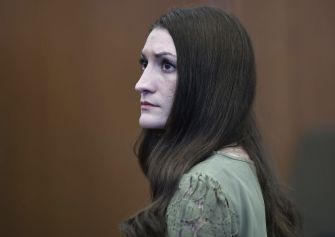
Photo Source: Greg Derr/The Patriot Ledger-Pool/AP via apnews.com
Lindsay Clancy’s murder trial ended in a mistrial Friday after a Massachusetts jury failed to reach a unanimous verdict on whether she was criminally responsible for killing her three young children.
Plymouth Superior Court Judge William Sullivan formally discharged the jury after seven days and about 36 hours of deliberations. It was the third time jurors told the court they remained deadlocked.
The jury had first reported an impasse Tuesday and remained deadlocked Wednesday again, prompting Sullivan to give Massachusetts’ final deadlock instruction, known as a Tuey-Rodriguez or “dynamite” charge. The instruction urged jurors to reconsider one another’s views without abandoning an honestly held belief. When the panel returned Friday and reported a third deadlock, Sullivan had reached the point where he could declare a mistrial.
Before dismissing the panel, Sullivan gave Clancy’s attorneys one hour to seek emergency relief over a dispute involving an alleged holdout juror. Massachusetts Supreme Judicial Court Associate Justice Dalila Argaez Wendlandt denied the request Friday afternoon, clearing the way for the trial to end without a verdict.
Clancy, 36, remains charged with three counts of first-degree murder in the January 2023 deaths of her children, Cora, 5, Dawson, 3, and Callan, 8 months, at the family’s home in Duxbury.
She does not dispute that she strangled the children with exercise bands before attempting to take her own life, leaving her paralyzed. The six-week trial instead centered on whether she was legally responsible for the killings.
Her attorneys argued that Clancy was experiencing postpartum psychosis and could not appreciate the wrongfulness of her actions. Prosecutors maintained that she understood what she was doing and deliberately planned the killings despite her documented mental health struggles.
The jury dispute emerged late in deliberations when the foreperson raised concerns about one member of the panel. According to statements made in court, the foreperson said the juror acknowledged having doubt but would not properly apply the judge’s instructions on reasonable doubt.
Defense attorney Kevin Reddington sought to have the juror removed and replaced with an alternate. He argued that the problem went beyond an ordinary disagreement over the evidence and said the remaining jurors appeared to be aligned against the holdout.
Sullivan refused to remove the juror or conduct the additional questioning requested by the defense.
Massachusetts law sharply limits when a juror can be replaced after deliberations begin. A judge can generally remove someone because of a personal circumstance that prevents continued service, such as illness, but not because of the juror’s view of the evidence or disagreement with the panel, a restriction intended to protect the independence of deliberations.
Sullivan instead reminded jurors that they were required to follow his instructions on reasonable doubt and sent them back to deliberate Friday morning.
About 90 minutes later, the jury again reported that it could not reach a unanimous decision.
“It is with a heavy heart that we report we are unable to come to a unanimous decision,” the jury wrote.
Sullivan formally ended the trial after Wendlandt declined the defense’s emergency request to intervene.
The mistrial is neither a conviction nor an acquittal. Because there is no verdict, there is no guilty or not-guilty judgment for either side to appeal, and the three murder charges against Clancy remain pending.
With the jury discharged, its members may now choose to discuss the trial publicly or speak with reporters. They are not required to do so, and Massachusetts guidance advises former jurors against revealing the identities or votes of other jurors or disclosing what was said during private deliberations.
Reddington said the panel appeared to be divided 11-1, although the jury itself did not publicly disclose its vote.
The next decision belongs to Plymouth County District Attorney Timothy Cruz.
A mistrial caused by a genuinely deadlocked jury generally allows prosecutors to try the case again without violating constitutional protections against double jeopardyDouble jeopardy is the constitutional protection that generally prevents a person from being prosecuted or punished more than once for the same criminal offense. The protection appears in the Fifth Amendment and applies to both federal and state prosecutions.Read more →. Cruz said Friday that no decision on a retrial would be made that day and that prosecutors would meet before returning to court.
A second trial would require a new schedule and an entirely new jury.
Both sides would also return to a case that generated weeks of testimony from more than 80 witnesses and roughly 300 exhibits. Any retrial would revisit much of that record, with prosecutors and the defense likely to reassess witnesses, testimony and strategy. A full transcript of the six-week proceeding would also take time to produce, adding to the work before the case could be tried again.
Clancy remains held without bail at Tewksbury State Hospital, where she has received psychiatric and medical care while the criminal case proceeds. The mistrial does not automatically entitle her to release because the first-degree murder charges remain pending.
Massachusetts defendants charged with first-degree murder do not have a right to bail, although a Superior Court judge has discretion to grant it. Clancy’s attorneys could ask the court to reconsider her custody while the case remains unresolved, but no order releasing her has been issued.
The case is scheduled to return to Plymouth Superior Court for a status hearing at 9 a.m. on September 29, when prosecutors could provide the first indication of whether they intend to put Clancy on trial again.
Share This Article
If you found this article insightful, consider sharing it with your network.
Alexandra Agraz is a former Diplomatic Aide with firsthand experience in facilitating high-level international events, including the signing of critical economic and political agreements between the United States and Mexico. She holds dual associate degrees in Humanities, Social and Political Sciences, and Film, blending a diverse academic background in diplomacy, culture, and storytelling. This unique combination enables her to provide nuanced perspectives on global relations and cultural narratives.
Lindsay Clancy’s attorneys are asking a Massachusetts judge to dismiss the murder charges against her, arguing that the September 4 mistrial violated constitutional protections against double jeopardy because the court ended deliberations without sufficiently examining concerns about the lone holdout juror.Attorneys Martin Weinberg and Kevin Reddington filed the motion Monday...
Read
More »
The murder trial of Lindsay Clancy ended without a verdict after seven days of deliberations, even though three jurors now say 11 members of the panel believed she should be found not guilty by reason of insanity.For families and observers who followed the case closely, that outcome can feel difficult...
Read
More »
Lindsay Clancy’s defense lawyer asked President Donald Trump to pardon her after her Massachusetts murder trial ended in a mistrial, even though presidential pardon power does not extend to the state murder charges against her.Attorney Kevin Reddington made the appeal Tuesday on ABC’s “Good Morning America,” asking Trump to consider...
Read
More »
Jurors in the Lindsay Clancy murder trial told the judge for a second straight day Wednesday that they could not reach a unanimous verdict, prompting a rare jury instruction and moving the case closer to a possible mistrial.The 12-member panel ended its fifth day of deliberations without a verdict after...
Read
More »
The Ohio Supreme Court on Tuesday denied Mackenzie Shirilla’s latest bid to revive her postconviction challenge, refusing to reconsider its June decision not to hear an appeal stemming from a petition filed one day late.The court issued no opinion explaining the denial. Justices Patrick DeWine and Jennifer Brunner dissented. DeWine...
Read
More »
We use cookies and similar technologies to help our website function, understand how visitors use our site, and improve your experience. Some cookies are necessary for the website to operate, while others may be used for analytics or advertising.