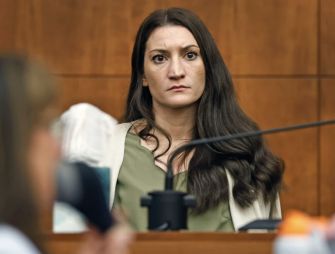
Lindsay Clancy’s murder trial is nearing its final stage after her defense rested Friday and prosecutors called a psychiatrist to challenge claims that postpartum psychosis left her not criminally responsible for killing her three children.
Clancy, 36, has pleaded not guilty to three counts of first degree murder in the deaths of Cora, 5, Dawson, 3, and Callan, 8 months, at the family’s Duxbury home on Jan. 24, 2023. She has admitted causing their deaths. The dispute before jurors in Plymouth Superior Court centers on whether she was criminally responsible under Massachusetts law when the killings occurred.
Defense lawyers ended their case with testimony from forensic psychiatrist Dr. Phillip Resnick, who told jurors that Clancy was psychotic and experiencing a command hallucination at the time. Resnick testified that she believed an outside force had taken control of her body and that her distorted thinking led her to believe she was sending the children to heaven.
Prosecutors responded by calling forensic psychiatrist Dr. Avram Mack as a rebuttal witness. Mack testified that Clancy suffered from major depression and anxiety, but he rejected the defense position that she was psychotic or experiencing mania when the children were killed. He concluded that she retained the capacities required for criminal responsibility.
Massachusetts refers to what is commonly called an insanity defense as a lack of criminal responsibility. A psychiatric diagnosis alone does not decide the issue. A person is not criminally responsible if a mental disease or defect caused the person to lack substantial capacity either to understand the criminality or wrongfulness of the conduct or to conform that conduct to the requirements of the law.
“Mental disease or defect” is a legal term and does not depend on a specific medical diagnosis. A jury can therefore find that someone had a serious mental illness while still concluding that the person was criminally responsible if prosecutors prove the person could meaningfully understand that the conduct was wrong or illegal and could control their actions.
The burden remains with the Commonwealth. Once criminal responsibility is properly at issue, Clancy does not have to prove that she lacked it. Prosecutors must establish beyond a reasonable doubt that she was criminally responsible, either by showing that she did not have a qualifying mental disease or defect or that any condition she had did not deprive her of the required ability to understand or control her conduct.
Jurors are not required to accept either psychiatrist’s conclusion. They may weigh expert testimony alongside Clancy’s actions before, during and after the killings. Prosecutors have pointed to evidence they say shows planning and awareness, including Clancy sending her husband out of the house before the children were killed. Her lawyers argue that her behavior must be considered alongside a worsening psychiatric condition, medication changes and reported hallucinations.
Mental health evidence may also affect what degree of homicide the jury considers if prosecutors first prove criminal responsibility. The Commonwealth is pursuing first degree murder under theories that include deliberate premeditation and extreme atrocity or cruelty. Deliberate premeditation requires proof that a person formed an intent to kill after reflection, although Massachusetts law does not require that reflection to last for any set amount of time.
Jurors may consider evidence of mental impairment when deciding whether prosecutors proved the intent and premeditation required for first degree murder. That question is separate from criminal responsibility, which asks whether mental disease or defect deprived a person of the legal capacity to understand or control the conduct in the first place.
Clancy did not testify before the defense rested. Prosecutors are continuing rebuttal testimony, with proceedings scheduled to resume Monday in Plymouth Superior Court. Closing arguments are expected after the rebuttal case is completed before Judge William Sullivan sends the charges to the jury.